Maintain leaf litter
Leave a thin, continuous layer of undecayed leaf litter over the soil, as this provides the natural microhabitat and slow nutrient release that supports the mycorrhizal fungi associated with Gliophorus graminicolor.

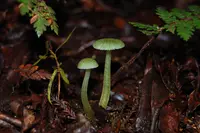
Gliophorus graminicolor is a small grassland mushroom known for its vivid green to blue-green caps and slender, often similarly colored stems. It belongs to the waxcap group, a cluster of fungi associated with low-nutrient, unimproved grasslands.
This species typically appears scattered or in small groups among short grasses or moss, mainly in temperate regions of the Southern Hemisphere, especially New Zealand and parts of Australia. It is not a plant for conventional gardening, as it depends on specific soil conditions and long-term grassland management.
Because its ecology is specialized, it is challenging to encourage or grow intentionally. For most people, how to care for Gliophorus graminicolor mainly means conserving suitable grassland habitat and avoiding soil disturbance or heavy fertilization.

Care Difficulty
Hard Care

Light Preference
Partial Shade

Water Requirements
Keep Soil Moist

Temperature Preference
Cool Climate

Hardiness Zone
Unknown

Soil Texture
Loamy, Silty, Organic-rich

Soil pH
Strongly acidic (4.5–5.5), Acidic (5.5–6.5)

Soil Drainage
Moist but well-drained

Fertilization
Minimal (feed rarely)
Scan your plant to receive care tips personalized for your specific plant
Available on iOS and Android
This grassland waxcap prefers cool, moist sites with soft, filtered light rather than strong direct sun.
This waxcap relies on consistently moist but not saturated soil in established grassland rather than direct, frequent watering.
This grassland fungus favors cool, moist conditions and declines in prolonged heat or severe frost.
This grassland fungus prefers consistently moist air but survives a moderate humidity range outdoors.
This species fruits best in cool, moist, organically enriched turf rather than in typical potting substrates.
This fungus is not well suited to conventional container growing because it depends on stable grassland soil and turf structure.
This forest fungus normally relies on natural soil nutrients and does not need routine fertilization in gardens or containers.
Pruning is not part of normal care for Gliophorus graminicolor, as the visible mushroom is only a temporary fruiting body.
Transplanting focuses on preserving the undisturbed soil community that supports this grassland waxcap fungus.
Propagation of this waxcap is specialized and rarely undertaken by home growers.
No special winter care is required, as this fungus is adapted to natural seasonal cycles in temperate climates.

Plant Health Check
Not sure what's wrong with your plant? Check your plant's health inside the app.
This waxcap’s bright grass-green color comes from unique fungal pigments rather than chlorophyll, so it does not photosynthesize despite its vivid, plant-like appearance.
The species is strongly associated with long-unimproved grasslands and is often used by mycologists as an indicator of old, low-nutrient, traditionally managed meadows and lawns.
The fruiting body has a distinctly slimy, translucent cap and stem when moist, a hallmark of waxcap fungi that helps distinguish it from many other small green mushrooms.

In some regions of Europe and New Zealand, this species is of conservation interest because its presence reflects historically continuous, low-intensity land use that has become increasingly rare in modern agricultural landscapes.
This small waxcap mushroom is not commonly eaten and is generally regarded as inedible. It is not known for toxic compounds, but identification errors with similar species pose risks, so consumption is not recommended.
Keep your plants happy and healthy with plant identification, disease detection, and easy care guidance.