

Habitat-style planting
Establish this fungus in an undisturbed, low-nutrient grass area rather than rich beds, and avoid overseeding or frequent reseeding so the associated grass–fungus community can stabilize over several seasons.

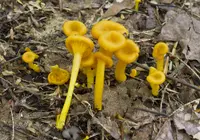
Shining waxcap, Gloioxanthomyces nitidus, is a small, brightly colored mushroom rather than a leafy houseplant. It forms smooth, slimy, yellow to orange caps with slender, fragile stems. In nature it grows on mossy soil or decaying plant material in damp forests and grasslands, especially in cooler regions of North America.
This fungus relies on specific soil and habitat conditions, so it is not easy to cultivate intentionally. For those exploring how to care for shining waxcap, it generally prefers consistently moist, undisturbed, low-nutrient ground with plenty of moss and leaf litter.

Care Difficulty
Hard Care

Light Preference
Partial Shade

Water Requirements
Keep Soil Moist

Temperature Preference
Cool Climate

Hardiness Zone
Unknown

Soil Texture
Loamy, Silty, Organic-rich

Soil pH
Strongly acidic (4.5–5.5), Acidic (5.5–6.5)

Soil Drainage
Moist but well-drained

Fertilization
Minimal (feed rarely)
Scan your plant to receive care tips personalized for your specific plant
Available on iOS and Android
This fungus prefers cool, moist, lightly shaded habitats rather than strong, direct sun.
Gloioxanthomyces nitidus develops best in consistently moist, but not waterlogged, ground.
This species favors cool to mild conditions and declines in prolonged heat or severe frost.
This fungus prefers cool, moist air but usually grows outdoors where humidity is naturally adequate.
Gloioxanthomyces nitidus fruits best in consistently moist, light soils with high organic content.
This species is poorly suited to conventional container growing and is best managed in the ground or natural substrates outdoors.
This fungus is not a typical container or garden plant and generally does not need fertilizing when growing in natural soil.
Pruning is not a standard practice for Gloioxanthomyces nitidus, as the fruiting bodies are seasonal and short-lived.
This species is best left undisturbed in situ, as its mycelium relies on stable soil conditions and associated microorganisms.
Propagation of this wild fungus is technically complex and rarely attempted in home settings.
In its natural range, this fungus is cold hardy and does not need dedicated winter care.

Plant Health Check
Not sure what's wrong with your plant? Check your plant's health inside the app.
This fungus is strongly associated with wet, nutrient-poor habitats such as Sphagnum bogs and calcium-rich fens, often fruiting among mosses on saturated, organic soils.
Its small, bright yellow to orange-yellow caps have a shiny, slightly sticky, waxy surface when moist, which helps distinguish it from duller or more fibrous grassland waxcaps.
The stem typically contains a translucent, gelatinous core that makes the fruiting body flexible and somewhat slippery, a feature used by mycologists to separate it from similar-looking yellow mushrooms.
This species is considered edible but is small and not widely collected for food. Identification of waxcap fungi can be difficult, so only experienced foragers should harvest it and avoid all look-alikes that cannot be confirmed safely.
Keep your plants happy and healthy with plant identification, disease detection, and easy care guidance.

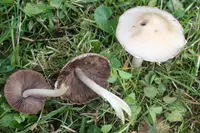
Pale Brittlestem
Candolleomyces candolleanus
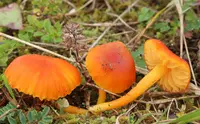
Honey Waxcap
Hygrocybe reidii
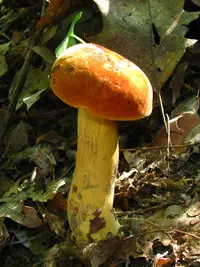
Boletus subluridellus
Boletus subluridellus
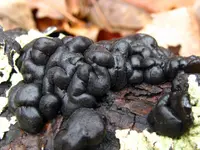
Black Witches' Butter
Exidia glandulosa
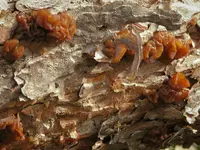
pine jelly
Exidia saccharina
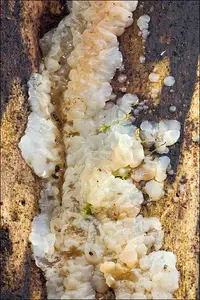
White Brain
Exidia thuretiana
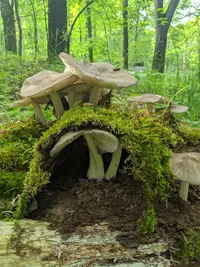
Eastern American Platterful Mushroom
Megacollybia rodmanii
mountain moss deconica
Deconica montana