


Use fresh hardwood
Prepare your fruiting beds with fresh to 1-year seasoned hardwood chips or coarse sawdust from oak, beech, or maple, since this species colonizes lignin-rich woody debris much more reliably than compost or garden soil.

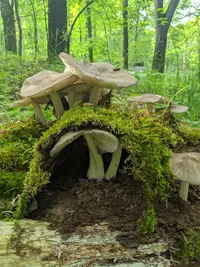
The Eastern American platterful mushroom, Megacollybia rodmanii, is a wood-decaying fungus rather than a traditional garden plant. It forms broad, pale to grayish caps with slender stems, usually appearing in clusters on decaying hardwood logs or buried wood in eastern North American forests.
This species plays an important role in breaking down dead wood and recycling nutrients back into the soil. Gardeners interested in how to care for Eastern American Platterful Mushroom mainly manage habitat, since it depends on consistently moist, shaded conditions and access to old wood rather than standard soil-based cultivation.

Care Difficulty
Hard Care

Light Preference
Shade

Water Requirements
Keep Soil Moist

Temperature Preference
Cool Climate

Hardiness Zone
Unknown

Soil Texture
Loamy, Organic-rich

Soil pH
Acidic (5.5–6.5)

Soil Drainage
Moist but well-drained

Fertilization
Minimal (feed rarely)
Scan your plant to receive care tips personalized for your specific plant
Available on iOS and Android
This woodland fungus prefers low, filtered light conditions rather than direct sun exposure.
Moist, cool, and consistently damp conditions are essential for healthy development of this wood-decaying fungus.
This species thrives in cool to mild conditions typical of shaded, moist forests.
This woodland fungus requires consistently moist, humid conditions to fruit reliably.
This species fruits best from a loose, decayed-wood substrate rather than typical garden soil.
This fungus can be grown in containers, but only when the pot mimics a cool, moist, decomposing wood environment.
Megacollybia rodmanii grows on decaying wood and usually needs no added fertilizer in natural or garden settings.
Pruning Megacollybia rodmanii is limited to hygienic removal of spent fruiting bodies rather than true structural pruning.
This fungus is not grown in standard pots; management focuses on placing or replacing its woody substrate rather than conventional repotting.
Propagation of Megacollybia rodmanii relies on mycelium and spore spread rather than typical plant-style methods, so home multiplication is limited.
In most temperate climates this woodland fungus tolerates normal winter conditions and needs little targeted care.

Plant Health Check
Not sure what's wrong with your plant? Check your plant's health inside the app.
For many years this fungus was treated as part of Megacollybia platyphylla, but DNA-based studies showed that North American material included a distinct lineage now recognized as Megacollybia rodmanii.
Compared with related species, it shows a notably fibrous, often tough stem that tends to split lengthwise, which field mycologists use as one of several characters to help separate it from look-alikes.
This species is a saprobe, meaning it feeds on dead organic matter, and it is most often found on well-decayed hardwood logs or buried wood, where it helps break down lignin- and cellulose-rich tissues.
Identification of wild fungi is complex, and this species is not widely regarded as a choice edible. Look-alike mushrooms can be dangerously toxic. For safety, avoid eating it unless identified on-site by a qualified mycologist.
Keep your plants happy and healthy with plant identification, disease detection, and easy care guidance.

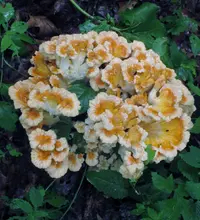
White-pored Chicken of the Woods
Laetiporus cincinnatus
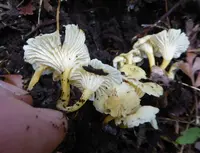
Cantharellus wellingtonensis
Cantharellus wellingtonensis
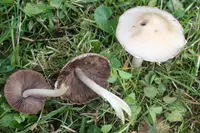
Pale Brittlestem
Candolleomyces candolleanus
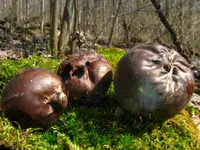
Tumbling puffball
Bovista pila
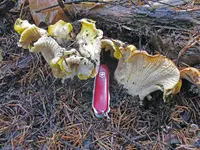
Cascade chanterelle
Cantharellus cascadensis
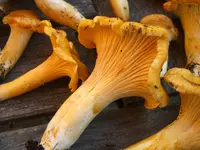
Pacific Golden Chanterelle
Cantharellus formosus
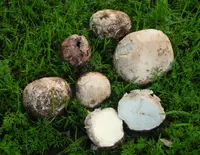
Lead-grey Puffball
Bovista plumbea
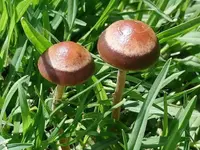
belted panaeolus
Panaeolus cinctulus