Substrate inoculation method
Mix colonized sawdust spawn thoroughly into a deep layer of sterilized conifer sawdust or well-decayed conifer duff in a shaded outdoor bed to give the mycelium a strong starting advantage over competing fungi.

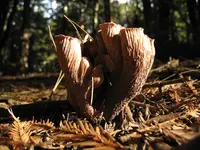
Gomphus clavatus, commonly called pig's ears, is a club-like fungus rather than a true plant. It forms thick, violet-brown, ear-shaped clusters with wrinkled, folded surfaces. These fruiting bodies grow low to the ground, often in groups. In nature, pig's ears occur in coniferous and mixed forests of North America and Europe, where they form mycorrhizal partnerships with tree roots. This close dependency on specific forest conditions makes them difficult to cultivate at home. For those learning how to care for pig's ears, it is important to understand that this species prefers cool, moist, shaded woodland environments and undisturbed, well-drained forest soils.

Care Difficulty
Hard Care

Light Preference
Shade

Water Requirements
Keep Soil Moist

Temperature Preference
Cool Climate

Hardiness Zone
Unknown

Soil Texture
Loamy, Silty, Organic-rich

Soil pH
Strongly acidic (4.5–5.5), Acidic (5.5–6.5)

Soil Drainage
Moist but well-drained

Fertilization
Minimal (feed rarely)
Scan your plant to receive care tips personalized for your specific plant
Available on iOS and Android
This woodland fungus prefers cool, shaded forest conditions rather than direct open sun.
This mycorrhizal fungus depends on consistently moist, not waterlogged, forest soil.
This species prefers cool to mild conditions typical of shaded, moist forests.
This fungus prefers consistently moist, cool air, so humidity matters where it is cultivated as pig's ears.
Gomphus clavatus is a mycorrhizal fungus, so focus on recreating its natural forest floor substrate rather than standard potting soil.
This species is generally unsuitable for container growing, because it depends on mycorrhizal association with tree roots in stable ground conditions.
Gomphus clavatus is usually grown in naturalistic, unfertilized conditions, so extra feeding is minimal for healthy colonies of pig's ears.
Pruning needs for Gomphus clavatus are minimal and focus on hygiene rather than shaping.
This fungus is not suited to normal container culture, so care focuses on minimal-disturbance transplanting of colonized material.
Propagation of Gomphus clavatus in home settings is challenging and seldom reliable.
In suitable climates, this woodland fungus is naturally cold hardy and requires little targeted winter care.

Plant Health Check
Not sure what's wrong with your plant? Check your plant's health inside the app.
This species forms dense, club- or fan-shaped fruiting bodies in shades of lilac to violet that often fade to buff with age, a color change frequently used as a field identification feature.
It forms ectomycorrhizal associations with conifers such as spruce and fir, exchanging mineral nutrients and water from the soil for carbohydrates from the host tree.
In several European countries this fungus is considered rare and appears on regional Red Lists, mainly due to forest habitat changes and loss of old, undisturbed conifer woodlands.

Historical records and older field guides often list this species under the genus Cantharellus or Craterellus, reflecting how its unusual clubbed form and wrinkled underside blurred the boundaries between major fungal groups in earlier taxonomic systems.
This fungus is considered edible when young and healthy, but quality varies and it can be confused with toxic look-alikes. Only experienced foragers should collect it, and always cook thoroughly before eating.
Keep your plants happy and healthy with plant identification, disease detection, and easy care guidance.