

Elevated mounting
Mount the fern on a slab of bark or a shallow, well-draining basket and hang it slightly tilted so excess water runs off the rhizomes, which reduces rot and mimics its natural epiphytic growth habit.

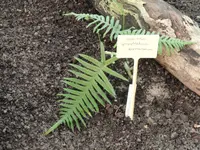
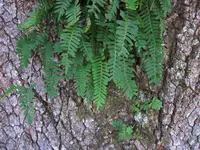
Goniophlebium formosanum is an epiphytic fern, often found growing on tree trunks or rocks, forming arching clumps of narrow, leathery fronds. The fronds are usually bright to deep green, creating a fine-textured, layered look that suits naturalistic or woodland-style plantings.
This species is native to parts of East Asia, where it grows in warm, humid forests with filtered light and consistent moisture. Its preference for stable humidity and airy, organic substrates makes it slightly more demanding than common houseplants, but still manageable for attentive growers. Understanding how to care for Goniophlebium formosanum mainly involves providing gentle light, even moisture, and good air circulation.

Care Difficulty
Moderate Care

Light Preference
Partial Shade

Water Requirements
Keep Soil Moist

Temperature Preference
Tropical / Frost Sensitive

Hardiness Zone
10–11

Soil Texture
Loamy, Peaty, Organic-rich

Soil pH
Acidic (5.5–6.5), Slightly acidic (6.5–7.0)

Soil Drainage
Moist but well-drained

Fertilization
Light (every 4–6 weeks)
Scan your plant to receive care tips personalized for your specific plant
Available on iOS and Android
This fern prefers soft, filtered light that mimics a forest understory environment.
This species prefers evenly moist, never soggy soil around its shallow roots.
This fern grows best in mild, stable temperatures with protection from both frost and intense heat.
This fern prefers consistently moist air and reacts quickly to dry indoor conditions.
This species needs a loose, moisture-retentive but fast-draining mix similar to an epiphytic fern substrate.
This fern is well suited to container culture, especially in hanging baskets or shallow, wide pots.
Light feeding supports steady growth for Goniophlebium formosanum without forcing soft, weak fronds.
Pruning needs are minimal and focus on tidying and maintaining healthy fronds on Goniophlebium formosanum.
Repotting or transplanting is occasional and mainly needed when the root system outgrows its space.
Propagation of Goniophlebium formosanum is typically done by careful division of rhizomes rather than by spores for home growers.
Winter care depends on climate, as this fern is not tolerant of hard freezes, especially in containers.

Plant Health Check
Not sure what's wrong with your plant? Check your plant's health inside the app.
This species naturally grows on shaded rocks and cliffs in Taiwan and nearby East Asian regions, anchoring its creeping rhizomes into small crevices rather than deep soil.
Its fronds are once-pinnatifid, meaning they are deeply lobed but not fully divided into separate leaflets, giving the plant a characteristic ruffled, strap-like appearance along the rock surface.
Unlike many ferns that prefer forest floor humus, this species is typically epipetric, adapted to thin, often nutrient-poor substrates on rock faces where moisture and organic matter accumulate only in small pockets.
This fern spreads slowly by short creeping rhizomes. In pots it usually stays contained, gradually filling the container. In the ground, it can form small clumps over time but is not considered aggressive in typical garden settings.
Keep your plants happy and healthy with plant identification, disease detection, and easy care guidance.

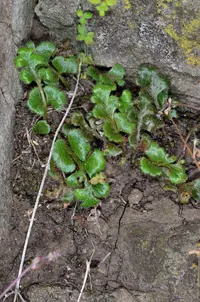
Blanket Fern
Asplenium subglandulosum
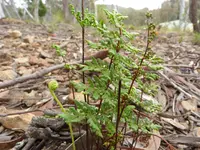
Hemionitis austrotenuifolia
Hemionitis austrotenuifolia
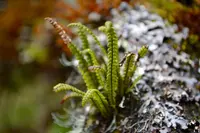
Grammitis moniliformis
Grammitis moniliformis
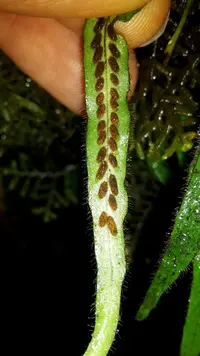
Grammitis pseudociliata
Grammitis pseudociliata
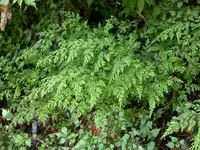
Sichuan lace
Onychium japonicum
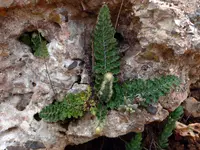
Scaly Lip Fern
Cosentinia vellea
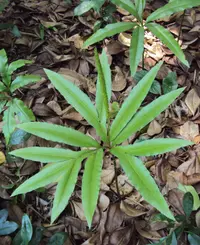
kamraj
Helminthostachys zeylanica
resurrection fern
Pleopeltis michauxiana