

Mounting strategy
Attach the fern to a long-lasting, textured mount such as cork bark or fern fiber, positioning rhizomes on the surface and securing them loosely with soft ties or fishing line so new roots can anchor without constriction.

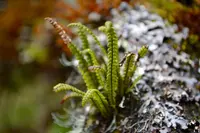
Grammitis moniliformis is a small, delicate fern that typically grows as an epiphyte, anchoring itself on tree trunks, mossy branches, or rocks. It forms fine, narrow fronds that create a soft, tufted appearance rather than a broad leafy clump.
This species occurs mainly in humid, montane forests, where it benefits from constant moisture, moving air, and filtered light. Its thin fronds and shallow root system make it sensitive to drying out and to heavy handling, which can complicate how to care for Grammitis moniliformis.
In cultivation it generally prefers cool to mild temperatures, high humidity, gentle air movement, and a very open, mossy or bark-based substrate that never stays waterlogged for long periods.

Care Difficulty
Hard Care

Light Preference
Shade

Water Requirements
Keep Soil Moist

Temperature Preference
Tropical / Frost Sensitive

Hardiness Zone
Unknown

Soil Texture
Peaty, Organic-rich

Soil pH
Strongly acidic (4.5–5.5)

Soil Drainage
Moist but well-drained

Fertilization
Minimal (feed rarely)
Scan your plant to receive care tips personalized for your specific plant
Available on iOS and Android
This small epiphytic fern prefers soft, filtered light that mimics shaded forest canopies.
This fern needs consistently moist, airy conditions around its roots or mounting surface.
This species prefers mild, stable temperatures similar to a cool to warm rainforest understory.
This fern prefers consistently humid air and reacts quickly to dry indoor conditions.
This species needs a loose, airy, organic-rich substrate that mimics moist forest humus.
This fern adapts well to container culture when moisture and root aeration are carefully managed.
This small epiphytic fern grows slowly and needs only light, occasional nutrition in cultivation.
Pruning needs for this fern are minimal and focus on cleanliness rather than shaping.
Handling this fern should be gentle, as its fine roots and rhizomes resent disturbance.
Propagation of this fern is possible but slow and better suited to patient growers.
This fern is not frost hardy and needs protection in regions with cold winters.

Plant Health Check
Not sure what's wrong with your plant? Check your plant's health inside the app.
This species is a small epiphyte that naturally grows on tree trunks and branches in humid neotropical forests, rather than rooting in soil on the ground.
Its fronds are divided into a chain of small, rounded segments that give a distinctive moniliform, or bead-like, appearance compared with the continuous blades of many other ferns.
In its native range it is often associated with moist, shaded montane or cloud forests, where constant high humidity and frequent mist support its delicate fronds and exposed root system.
This small epiphytic fern works well in terrariums, cool orchid cases, or very humid bathrooms. It needs stable warmth, high humidity, and gentle air movement. Grammitis moniliformis indoor care is challenging without controlled conditions.
Keep your plants happy and healthy with plant identification, disease detection, and easy care guidance.

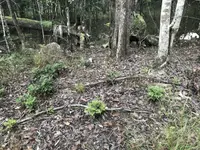
Hemionitis concolor
Hemionitis concolor
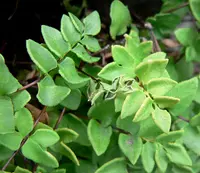
Brewer's cliffbrake
Hemionitis breweri
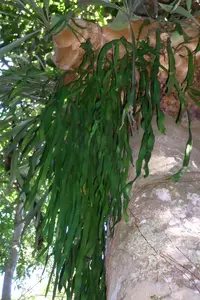
Old World adderstongue
Ophioglossum pendulum
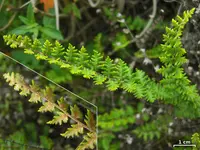
Myriopteris aurea
Hemionitis bonariensis
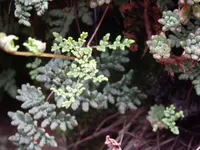
Hemionitis hispanica
Hemionitis hispanica
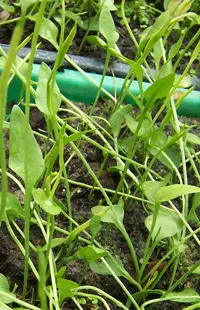
Least Adder's-tongue
Ophioglossum lusitanicum
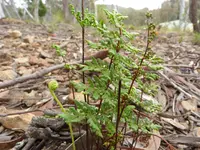
Hemionitis austrotenuifolia
Hemionitis austrotenuifolia
Hemionitis integerrima
Hemionitis integerrima