

Rocky mounting
Mount the root ball into a pocket of porous rock or a slotted fern basket filled with gritty mix to mimic its natural cliff habitat and improve drainage around the rhizomes.

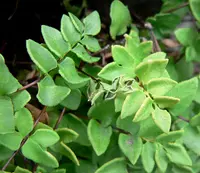
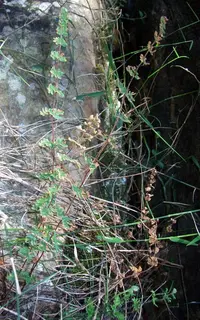
Brewer's cliffbrake (Hemionitis breweri) is a small, specialized fern adapted to rocky, often vertical habitats. It typically forms low clumps, with delicate fronds arising from crevices. The fronds are usually narrow and tough, designed to cope with strong light, drying winds, and shallow substrates. This species is native to limited, rocky regions, where it anchors into cracks rather than deep soil. Hemionitis breweri can be challenging to maintain because it dislikes constantly wet conditions yet still needs steady moisture at the roots. It prefers bright, indirect light, very sharp drainage, and good air movement, so anyone who wants to care for Brewer's cliffbrake should be prepared to mimic its natural cliff-like environment.

Care Difficulty
Hard Care

Light Preference
Partial Shade

Water Requirements
Keep Soil Moist

Temperature Preference
Tropical / Frost Sensitive

Hardiness Zone
11–12

Soil Texture
Loamy, Rocky, Organic-rich

Soil pH
Acidic (5.5–6.5)

Soil Drainage
Moist but well-drained

Fertilization
Light (every 4–6 weeks)
Scan your plant to receive care tips personalized for your specific plant
Available on iOS and Android
This fern prefers bright, filtered exposure that mimics light on a shaded rock face.
This species prefers consistently slightly moist, sharply drained substrate.
This fern favors mild, frost-free conditions with limited temperature swings.
This fern prefers moderately high humidity to keep fronds healthy and hydrated.
Hemionitis breweri grows best in a loose, moisture-retentive but fast-draining mix.
This species suits container growing when drainage and moisture balance are carefully managed.
This fern benefits from light, consistent feeding rather than heavy fertilization.
Pruning needs for Hemionitis breweri are minimal and focus on cleanliness and shape.
This species prefers stable conditions, so repotting Hemionitis breweri should be infrequent and gentle.
Propagation of Hemionitis breweri is possible but slower and more technical than many common houseplants.
This fern is not frost hardy and needs sheltered conditions in winter.

Plant Health Check
Not sure what's wrong with your plant? Check your plant's health inside the app.
This fern is naturally restricted to rocky, cliff-like habitats in parts of western North America, where it anchors in crevices with very little soil and endures strong light and periodic drying compared to many woodland ferns.
The fronds are unusually small and somewhat leathery for a fern, an adaptation that helps reduce water loss in its exposed, rocky habitat while still allowing efficient photosynthesis.
Populations often occur on calcareous, lime-rich rock, showing a tolerance for higher pH substrates that many other ferns would find challenging, which is important to understand when planning Hemionitis breweri care.
Growth is generally slow to moderate. In cultivation, this species often reaches about 10–25 cm tall and forms a small clump over several years, rather than spreading quickly or filling large areas.
Keep your plants happy and healthy with plant identification, disease detection, and easy care guidance.

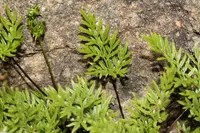
Indian's dream
Hemionitis densa
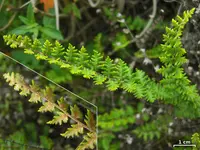
Myriopteris aurea
Hemionitis bonariensis
Hemionitis hispanica
Hemionitis hispanica
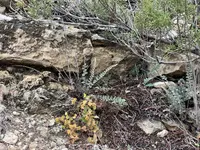
Hemionitis integerrima
Hemionitis integerrima
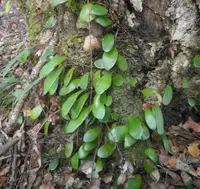
leather-leaf fern
Pyrrosia eleagnifolia
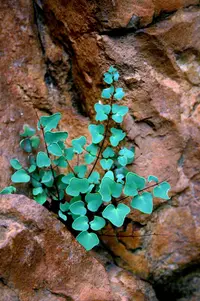
Hemionitis calomelanos
Hemionitis calomelanos
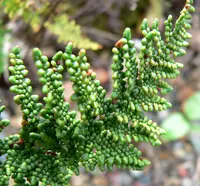
Cleveland's lip fern
Hemionitis clevelandii
bristly cloak fern
Hemionitis distans