Early plant support
Install short stakes or a low string trellis when plants are 10–15 cm tall so stems grow upright and do not lodge or snap once bolls start to develop weight.

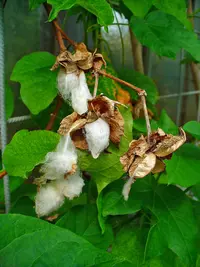
Levant cotton, Gossypium herbaceum, is a short-lived shrub grown for its fluffy cotton bolls and attractive, hibiscus-like flowers. It forms a bushy plant with lobed leaves and capsules that split open to reveal white or creamy fibers.
This species is native to arid and semi-arid regions of Africa and the Middle East, where it has long been cultivated as a fiber crop. It prefers warm temperatures, full sun, and well-drained soil, which guides how to care for Levant cotton in gardens or containers.
The plant is moderately easy to grow if it receives enough light and warmth, but it can struggle in cool, wet, or low-light conditions.

Care Difficulty
Moderate Care

Light Preference
Full Sun

Water Requirements
Moderate Water

Temperature Preference
Tropical / Frost Sensitive

Hardiness Zone
9–11

Soil Texture
Sandy, Loamy, Organic-rich

Soil pH
Acidic (5.5–6.5), Slightly acidic (6.5–7.0)

Soil Drainage
Well-drained

Fertilization
Moderate (every 2–4 weeks)
Scan your plant to receive care tips personalized for your specific plant
Available on iOS and Android
This species needs strong light to form compact plants and abundant bolls.
This plant prefers evenly moist but not saturated soil during active growth.
This warm-season crop needs stable heat to grow and set fiber properly.
This species prefers moderately dry air and generally does not need special humidity control indoors or outdoors.
This species prefers loose, well‑drained, slightly fertile soil that never stays waterlogged.
This species can be grown successfully in containers when provided with sufficient root depth and drainage.
Gossypium herbaceum benefits from moderate feeding during its active growing season for strong stems and good flowering.
Pruning Gossypium herbaceum helps manage size, improve air flow, and support flowering on well-lit stems.
When grown in containers, Levant cotton needs occasional repotting or transplanting to maintain healthy root growth.
New Gossypium herbaceum plants are most commonly started from seed under warm, bright conditions.
In most climates Gossypium herbaceum is grown as a warm-season annual and does not overwinter outdoors.

Plant Health Check
Not sure what's wrong with your plant? Check your plant's health inside the app.
This species is one of the main Old World cottons and was domesticated in parts of Africa and southwestern Asia long before New World cottons became dominant in global production.
Many traditional landraces of this plant produce brown or fawn-colored lint rather than pure white, which has been used historically to spin naturally colored textiles without chemical dyes.
The plant forms a deep taproot and small, somewhat leathery leaves, traits that help it tolerate hot, dry conditions in semi-arid regions where it has been cultivated for centuries.

Archaeological textile fragments and seeds show that this cotton was already cultivated and spun into thread in the Indus Valley and ancient Nubian regions several thousand years ago, making it one of the earliest extensively domesticated fiber crops in human history.
In warm, frost-free climates this species behaves as a short-lived perennial, producing multiple crops. In most temperate regions it is grown as a warm-season annual because freezing temperatures kill stems and often the root system.
Keep your plants happy and healthy with plant identification, disease detection, and easy care guidance.