Crown winter protection
In cold climates, fold older leaves over the central crown in late autumn and add a thick mulch of straw or coarse bark on top to protect the growth point from freeze damage.

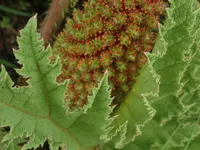
Chilean gunnera (Gunnera tinctoria) is a large, herbaceous perennial known for its huge, rough leaves that create a bold, architectural look in the landscape. It forms dense clumps with thick, knobbly rhizomes and thrives in cool, moist climates.
This species is native to southern Chile and nearby regions, where it grows along streams, wetlands, and damp meadows. In suitable conditions it can spread vigorously and may become invasive, so it suits larger gardens and controlled sites best.
To care for Chilean gunnera, gardeners usually provide consistently moist soil, shelter from strong drying winds, and a position with good light but protection from harsh, hot sun.

Care Difficulty
Hard Care

Light Preference
Partial Shade

Water Requirements
Keep Soil Moist

Temperature Preference
Cool Climate

Hardiness Zone
7–10

Soil Texture
Loamy, Silty, Organic-rich

Soil pH
Acidic (5.5–6.5), Slightly acidic (6.5–7.0)

Soil Drainage
Waterlogged tolerant

Fertilization
Light (every 4–6 weeks)
Scan your plant to receive care tips personalized for your specific plant
Available on iOS and Android
This large perennial prefers bright, mild conditions that mimic cool, moist stream edges.
This species demands constant moisture and is not drought tolerant.
This plant grows best in cool, moist climates with mild summers and frost protection at the crown.
This plant prefers very moist air to match its naturally boggy habitat.
This species thrives in permanently moist, deep, organic-rich ground.
This species is only marginally suitable for containers and is best kept in very large, outdoor tubs.
Gunnera tinctoria benefits from steady but moderate nutrition during its active growing season.
Pruning needs for Gunnera tinctoria focus on removing old foliage and managing plant size rather than shaping.
This species is usually grown in the ground, so focus on careful transplanting rather than frequent repotting.
Gunnera tinctoria is most commonly propagated by division, with seed used mainly for controlled or conservation-focused projects.
In many temperate areas Gunnera tinctoria needs crown insulation to survive freezing winters.

Plant Health Check
Not sure what's wrong with your plant? Check your plant's health inside the app.
In its native Chile, the petioles and flower stalks of this species have traditionally been used to produce a reddish dye, giving rise to the name tinctoria, which refers to dye-making. The leaf stalks are also sometimes eaten locally as a sour-tasting vegetable.
This species hosts filamentous cyanobacteria, mainly Nostoc, in specialized glands at the base of its leaf stalks. The cyanobacteria fix atmospheric nitrogen, supplying the plant with additional nutrients in poor soils.
Outside its native range in southern Chile and Argentina, this plant has become a serious invasive species in mild, wet regions such as western Ireland, the Isle of Man, and parts of New Zealand. It forms dense stands that outcompete native wetland vegetation and has been targeted by strict control measures.

This species produces separate male and female flowers on the same plant (it is monoecious) in a dense, cone-like inflorescence that can exceed 1 m in length, creating a massive flower spike that contrasts with its already oversized foliage.
Yellowing leaves usually come from water stress, nutrient deficiency, or compacted, anaerobic soil. Check that the root zone stays consistently moist but not waterlogged, improve drainage, and add a balanced slow‑release fertilizer with added magnesium and iron if needed.
Keep your plants happy and healthy with plant identification, disease detection, and easy care guidance.