Roots-in-pot check
Every 2–3 years, gently lift the plant from its pot at the start of spring to confirm the root system is firm, pale, and not circling tightly, then shift up only 1 pot size if roots densely line the sides and base.

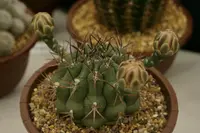
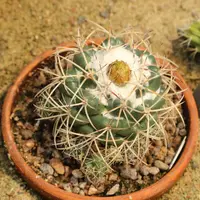
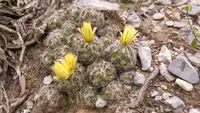
Gymnocalycium schickendantzii is a small globular cactus from northern Argentina, often forming clumps of rounded stems with pronounced ribs and sturdy spines. Plants stay compact, which makes them suitable for containers and small indoor collections.
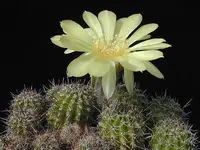
In spring or summer, it produces funnel-shaped flowers, usually white to pale pink, that contrast with the darker body. This species prefers bright light, very well-drained gritty soil, and careful watering that allows the roots to dry between waterings.
Thanks to its slow, steady growth and drought tolerance, many growers find it relatively straightforward to care for Gymnocalycium schickendantzii when basic cactus needs are met.

Care Difficulty
Moderate Care

Light Preference
Partial Sun

Water Requirements
Low Water

Temperature Preference
Warm Climate

Hardiness Zone
9–11

Soil Texture
Sandy, Rocky, Loamy

Soil pH
Slightly acidic (6.5–7.0), Neutral (7.0)

Soil Drainage
Well-drained

Fertilization
Minimal (feed rarely)
Scan your plant to receive care tips personalized for your specific plant
Available on iOS and Android
This cactus prefers bright conditions with some protection from intense midday sun.
Watering should be infrequent and guided by soil dryness rather than a fixed schedule.
Stable, warm conditions support healthy growth and flowering for this species.
This cactus handles typical indoor humidity and mainly needs protection from prolonged damp conditions.
This species needs a very fast-draining, mineral-rich soil to prevent root rot.
This cactus is very suitable for container growing due to its compact root system.
Light feeding supports healthy growth of Gymnocalycium schickendantzii in containers but heavy fertilization is unnecessary.
Pruning needs are minimal and mainly focused on hygiene for Gymnocalycium schickendantzii.
Container-grown plants benefit from occasional repotting to refresh the gritty mix and check root health.
Propagation of Gymnocalycium schickendantzii is usually done from offsets or seeds under warm, bright, and dry-stable conditions.
This cactus needs cool, very dry winter conditions rather than heavy insulation or covering.

Plant Health Check
Not sure what's wrong with your plant? Check your plant's health inside the app.
This species typically develops a flattened or slightly depressed stem that sits partially below the soil surface, an adaptation that helps protect it from intense sun and temperature extremes in its native habitats in northwestern Argentina.
Its white to pale pink, often fragrant flowers rise from a floral tube that is covered with scales and sometimes tiny spines, a feature that contrasts with many other Gymnocalycium species that have mostly smooth, naked flower tubes.
Mature plants show 9–14 broad ribs with sharply defined, chin-like tubercles and well-spaced areoles, creating a segmented appearance that helps channel water efficiently toward the root zone after rare rainfall events.

In habitat, Gymnocalycium schickendantzii often grows embedded among stones or in rocky crevices at higher elevations in Argentina, where its low profile and partially buried stem allow it to survive strong winds, intense ultraviolet radiation, and short periods of cold that would damage many other cacti.
This species grows slowly, typically adding only a few millimeters of diameter per year. With good light, a gritty mix, and moderate feeding, it may reach a modest clump-forming size over many years.
Keep your plants happy and healthy with plant identification, disease detection, and easy care guidance.