Correct host choice
Establish this fungus only in outdoor beds rich in decaying hardwood, such as old oak, beech, or mixed hardwood chips, since it fruits poorly on fresh softwood or pure bark mulch.

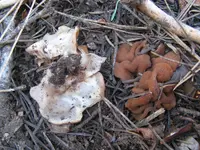
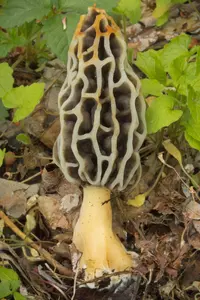
Pig's ears (Gyromitra perlata) is a fleshy fungus, not a true plant, recognized by its irregular, ear-shaped caps and stout, pale stems. It usually appears on soil or moss in mixed forests, often near decaying wood. This species occurs across parts of Europe and North America, emerging in cool seasons where conditions stay moist. It is challenging to cultivate at home because it relies on complex relationships with soil fungi and tree roots. For most people, it is better to admire it in nature than to attempt to care for pig's ears in a garden setting.

Care Difficulty
Hard Care

Light Preference
Partial Shade

Water Requirements
Regular Water

Temperature Preference
Cool Climate

Hardiness Zone
Unknown

Soil Texture
Loamy, Silty, Organic-rich

Soil pH
Acidic (5.5–6.5), Slightly acidic (6.5–7.0)

Soil Drainage
Moist but well-drained

Fertilization
Minimal (feed rarely)
Scan your plant to receive care tips personalized for your specific plant
Available on iOS and Android
This fungus prefers low, forest-floor light rather than direct sun exposure.
Moist, humus-rich forest soil supports reliable fruiting of this fungus.
Cool to mild conditions stimulate the best fruiting for this forest fungus.
Humidity is not a primary controllable factor for Gyromitra perlata, which fruits outdoors in naturally moist forest air rather than indoor environments like pig's ears houseplants.
This fungus develops best on decaying wood and very humus-rich forest soil rather than standard garden beds.
This species is not suitable for conventional container growing, as it relies on complex woodland substrates and natural microclimates that containers rarely replicate long term.
Gyromitra perlata grows as a wild fungus with tree roots and does not benefit from direct fertilization.
Pruning is not a standard practice for Gyromitra perlata, since it is a wild fungus rather than a garden plant.
Transplanting pig's ears (Gyromitra perlata) is generally not recommended because the fungus depends on a stable relationship with host tree roots and native soil fungi.
Propagation of Gyromitra perlata in gardens is considered impractical, as it relies on complex partnerships with host trees and soil microbes.
No specific winter care is needed, because Gyromitra perlata survives as underground mycelium and fruits seasonally when conditions suit it.

Plant Health Check
Not sure what's wrong with your plant? Check your plant's health inside the app.
The fruiting body of this fungus has a convoluted, brain‑like cap with irregular lobes, which distinguishes it in the field from many smooth‑capped morels and other cup fungi.
This species often appears in spring to early summer on soil rich in decaying hardwood debris, frequently near paths, clearings, or edges of mixed forests where light and litter conditions favor its growth.
It has a long history of confusion with other Gyromitra species, and only detailed study of cap shape, spore features, and microscopic tissue structure reliably separates it from close relatives.
This fungus is considered highly poisonous and must never be eaten, raw or cooked. It contains gyromitrin-type toxins that can damage the liver and nervous system and may be fatal, even in small amounts for some individuals.
Keep your plants happy and healthy with plant identification, disease detection, and easy care guidance.