Stabilize Substrate Edge
Create a 3–5 cm band of slightly coarser sand or fine gravel at the plot margins to reduce erosion and help new shoots anchor more securely in moving water.

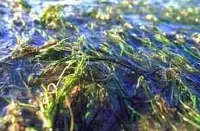
Shoalgrass, Halodule wrightii, is a small, marine seagrass that forms low, dense meadows in shallow coastal waters. It has narrow, ribbon-like leaves that spread by slender rhizomes, creating an underwater lawn.
This species is native to warm coastal regions, including the western Atlantic, Gulf of Mexico, and parts of the eastern Atlantic and eastern Pacific. Its flexible, fast-spreading growth helps stabilize sandy sediments and provides habitat for many marine animals.
Shoalgrass is sensitive to poor water quality, heavy turbidity, and physical disturbance, which can make it challenging to establish in restoration projects. Understanding how to care for Shoalgrass focuses mainly on stable, clean, well-lit, shallow marine conditions rather than typical home aquarium setups.

Care Difficulty
Hard Care

Light Preference
Full Sun

Water Requirements
Aquatic

Temperature Preference
Tropical / Frost Sensitive

Hardiness Zone
8–11

Soil Texture
Sandy, Silty, Organic-rich

Soil pH
Neutral (7.0), Slightly alkaline (7.0–7.5)

Soil Drainage
Waterlogged tolerant

Fertilization
Minimal (feed rarely)
Scan your plant to receive care tips personalized for your specific plant
Available on iOS and Android
Halodule wrightii thrives in bright, unobstructed coastal sun where water remains clear and shallow.
This seagrass depends on continuously submerged, moving seawater rather than intermittent surface watering.
This warm-temperate to tropical seagrass performs best in mild to warm coastal waters.
This marine seagrass requires fully submerged, water-saturated conditions rather than air humidity control.
This species anchors in soft marine sediments rather than conventional terrestrial potting soil.
This seagrass can be maintained in containers within marine aquaria or research systems if conditions are carefully managed.
Halodule wrightii usually grows in nutrient-poor marine sands, so heavy fertilization is neither necessary nor desirable.
Pruning Halodule wrightii is limited to maintenance rather than shaping, since it forms low, spreading seagrass beds.
Transplanting Halodule wrightii focuses on establishing and expanding seagrass beds rather than traditional container repotting.
Propagation of Halodule wrightii is commonly done vegetatively, using rhizome segments rather than seeds for reliable establishment.
Halodule wrightii is a warm-temperate to subtropical seagrass and lacks true frost tolerance, so winter care focuses on temperature management in artificial systems.

Plant Health Check
Not sure what's wrong with your plant? Check your plant's health inside the app.
This species is often the first seagrass to establish on newly stabilized or disturbed sandy bottoms, helping trap fine sediments and pave the way for slower-growing seagrass species.
Its narrow, ribbon-like leaves can be only 1–3 mm wide, yet the plant tolerates a broad salinity range, allowing it to grow in estuaries that experience strong freshwater and seawater mixing.
Dense meadows formed by this species provide shelter and feeding grounds for juvenile fishes, shrimp, and crabs, supporting coastal food webs and local fisheries.

This seagrass can complete its entire life cycle underwater, including flowering and producing seeds, making it one of the relatively few flowering plants fully adapted to a submerged marine existence.
Growth is relatively quick under ideal shallow, clear, marine conditions. Rhizomes can extend several cm per month, forming new shoots and patches within a single growing season, especially where water quality, salinity, and light are stable.
Keep your plants happy and healthy with plant identification, disease detection, and easy care guidance.