Root flare exposure
When planting, keep the uppermost roots and trunk flare slightly above soil level to reduce risk of collar rot and improve stability in wet or compacted ground.

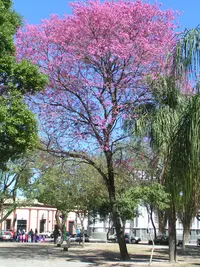
Pink trumpet tree (Handroanthus impetiginosus) is a deciduous flowering tree valued for its showy pink to purple trumpet-shaped blooms. It typically forms a medium to large, upright canopy with a straight trunk and palmate leaves.
This species is native to tropical and subtropical regions of Central and South America, where it often grows in seasonally dry forests. It is moderately slow-growing and tends to flower on bare branches after leaf drop, creating a very striking display.
Handroanthus impetiginosus prefers full sun, well-drained soil, and moderate moisture, and it shows fairly good drought tolerance once established. Gardeners who care for Pink trumpet tree usually find it manageable if planted in suitable climate zones with mild winters.

Care Difficulty
Moderate Care

Light Preference
Full Sun

Water Requirements
Moderate Water

Temperature Preference
Tropical / Frost Sensitive

Hardiness Zone
10–11

Soil Texture
Sandy, Loamy, Organic-rich

Soil pH
Acidic (5.5–6.5), Slightly acidic (6.5–7.0)

Soil Drainage
Well-drained

Fertilization
Minimal (feed rarely)
Scan your plant to receive care tips personalized for your specific plant
Available on iOS and Android
This sun-loving tree flowers best with strong, direct light in warm climates.
This species prefers deep, infrequent watering once established, with time for the soil to dry between soakings.
This tree thrives in warm, frost-free or near-frost-free climates with mild winters.
This species prefers moderate to slightly humid air but adapts to typical outdoor conditions in warm climates.
Soil for Handroanthus impetiginosus should be well-drained, slightly fertile, and never stay waterlogged.
This species can be grown in containers when young, but long-term cultivation requires very large, stable pots.
This tree responds to moderate feeding but can adapt to lean soils once established.
Pruning helps Handroanthus impetiginosus develop a strong framework and reliable flowering display.
This tree is usually grown in the ground, with container culture limited to young specimens.
Propagation of Handroanthus impetiginosus is usually done from seed and is moderately demanding.
This tropical to subtropical tree is sensitive to hard frost and needs protection in cooler climates.

Plant Health Check
Not sure what's wrong with your plant? Check your plant's health inside the app.
This species often flowers at the end of the dry season in its native South and Central American range, producing masses of pink to purple blossoms on almost leafless branches. That timing helps its flowers stand out to pollinators against an otherwise brown and sparse landscape.
The tubular flowers are mainly pollinated by large bees such as carpenter bees, which are strong enough to access the nectar and transfer pollen. This floral structure and timing reflect a close evolutionary adaptation to these heavy-bodied pollinators.
The wood, often marketed as ipe, is extremely dense and resistant to decay and insect attack due to its high content of protective compounds. Because of this durability, it has been widely used for outdoor structures like decking, though overharvesting has raised conservation concerns in some regions.

In several South American cities, long rows of this species are planted as street and park trees, creating large-scale, synchronized displays of pink blossom that have become seasonal cultural landmarks and are used as symbols of local identity in cities such as São Paulo and Asunción.
Lack of flowering usually comes from youth, insufficient winter chill, heavy shade, or excessive nitrogen fertilizer. Mature trees often need several dry, cooler months to set buds, so consistent seasonal conditions are important for reliable displays.
Keep your plants happy and healthy with plant identification, disease detection, and easy care guidance.