Encourage Deep Roots
In the first growing season, water less often but deeply to encourage a deep taproot, which improves drought tolerance and long-term stability in sandy or rocky soils.

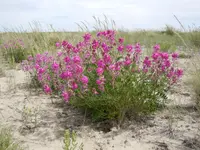
Boreal sweet-vetch, Hedysarum boreale, is a hardy perennial legume native to western and northern North America. It commonly grows in open forests, grasslands, and rocky slopes. Plants form clumps of upright stems with divided, fern-like leaves and showy clusters of purple to rose flowers followed by flat, jointed seed pods. This species fixes nitrogen in the soil, which supports its vigor and makes it useful in restoration plantings and low-input landscapes. Once established, it tolerates cold, drought, and poor soils, so many gardeners find it relatively straightforward to care for Boreal Sweet-vetch, given sunny conditions and well-drained ground.

Care Difficulty
Easy Care

Light Preference
Full Sun

Water Requirements
Low Water

Temperature Preference
Cold Hardy

Hardiness Zone
3–8

Soil Texture
Sandy, Loamy, Rocky

Soil pH
Slightly acidic (6.5–7.0), Slightly alkaline (7.0–7.5)

Soil Drainage
Well-drained

Fertilization
Minimal (feed rarely)
Scan your plant to receive care tips personalized for your specific plant
Available on iOS and Android
This cold-hardy perennial prefers strong light and does best in open sites with direct sun.
This species is drought-tolerant once established and prefers drier conditions over constant moisture.
This hardy legume thrives in cool to moderate climates and tolerates significant cold.
Hedysarum boreale tolerates a wide humidity range and usually needs no special humidity management outdoors in temperate climates.
Hedysarum boreale prefers lean, well-drained soil that stays airy around the roots.
This species can be grown in containers, though it performs best where roots have enough depth and drainage.
This nitrogen-fixing native legume needs minimal feeding in most soils, so focus on soil health rather than heavy fertilizer use.
Pruning needs for Hedysarum boreale are light and mainly focused on keeping plants tidy and flowering well.
This deep-rooted perennial is usually grown in the ground, so focus on careful transplanting rather than frequent repotting.
Propagation of Hedysarum boreale is most reliable from seed, with division used less often due to its taproot.
This species is cold hardy in much of North America and usually needs little specific winter care in the ground.

Plant Health Check
Not sure what's wrong with your plant? Check your plant's health inside the app.
This species is naturally distributed across high-elevation and boreal regions of western North America, where it is adapted to long, cold winters and short growing seasons.
The roots form nodules with rhizobia bacteria that convert atmospheric nitrogen into a plant-usable form, which helps enrich nutrient-poor soils and supports surrounding vegetation.
In its native range, this legume provides early-season forage for wildlife and livestock, offering protein-rich leaves and stems soon after snowmelt when other forage is still scarce.

Hedysarum boreale has been widely used in North American land restoration projects, especially along roadsides and disturbed rangelands, because it combines strong cold tolerance, deep roots that stabilize soil, and the ability to improve degraded sites through nitrogen fixation.
This species is very attractive to native bees, bumblebees, and some butterflies. Its pea-like flower clusters provide nectar and pollen. Planting several together in open, sunny sites increases visibility and benefits nearby pollinator populations.
Keep your plants happy and healthy with plant identification, disease detection, and easy care guidance.