Sturdy staking
Install sturdy stakes or a low wire fence early in the season and loosely tie stems as they elongate to prevent wind lodging and keep tall clumps upright and easier to maintain.

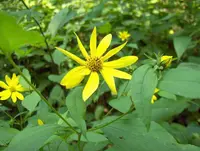
Paleleaf woodland sunflower, Helianthus strumosus, is a perennial wildflower native to eastern and central North America. It typically grows in open woods, thickets, and along woodland edges. Tall, slender stems carry narrow, pale green leaves and bright yellow, daisy-like flower heads that appear in late summer to early fall. Plants spread by rhizomes, forming loose colonies over time. This species is generally hardy and adaptable, tolerating a range of soils if drainage is reasonable. It favors full sun to light shade and consistent but not waterlogged moisture. For gardeners, understanding how to care for paleleaf woodland sunflower mainly involves giving it enough light and space to expand naturally.

Care Difficulty
Easy Care

Light Preference
Full Sun

Water Requirements
Moderate Water

Temperature Preference
Cold Hardy

Hardiness Zone
3–8

Soil Texture
Sandy, Loamy, Clay

Soil pH
Acidic (5.5–6.5), Slightly acidic (6.5–7.0)

Soil Drainage
Moist but well-drained

Fertilization
Minimal (feed rarely)
Scan your plant to receive care tips personalized for your specific plant
Available on iOS and Android
This species thrives in open, bright conditions typical of meadow or woodland-edge habitats.
This is a moderately thirsty perennial that prefers consistent soil moisture without prolonged saturation.
This hardy perennial is adapted to temperate climates with cold winters and warm summers.
This species is adapted to outdoor conditions and does not have special humidity requirements.
Helianthus strumosus prefers loose, moderately fertile mineral soil that stays evenly moist but does not stay saturated.
This tall, spreading species is possible in containers outdoors, but only in large, stable pots.
Native Helianthus strumosus typically needs minimal feeding in garden soil but responds to moderate nutrition on poor or sandy sites.
Pruning Helianthus strumosus helps manage height, encourage bushier growth, and maintain healthy stands.
This species is usually grown in the ground, so Helianthus strumosus care focuses on dividing and transplanting clumps rather than frequent repotting.
Helianthus strumosus is commonly propagated by division and seeds, both of which are straightforward with suitable timing and conditions.
This hardy perennial usually needs minimal winter care in its outdoor range, as the tops die back while underground parts survive freezing conditions.

Plant Health Check
Not sure what's wrong with your plant? Check your plant's health inside the app.
This species often spreads by thickened underground rhizomes, forming loose clonal patches in open woods and forest edges rather than tight roadside colonies like some other North American sunflowers.
Its characteristically pale to gray-green, rough leaves are thought to help reduce overheating and water loss in dappled woodland light compared with the darker foliage of many prairie sunflowers.
In parts of its range, the sunflower bee Andrena helianthi regularly visits this species, showing a strong preference for Helianthus pollen over that of many other composite flowers.

Genetic studies have shown that this woodland sunflower belongs to a complex group of closely related Helianthus species that readily hybridize, which makes accurate field identification challenging even for trained botanists.
This species spreads by rhizomes and self-seeding, forming expanding clumps over time. In fertile, moist soils it can become vigorous, so gardeners often control it by edging, dividing clumps, or removing unwanted seedlings regularly.
Keep your plants happy and healthy with plant identification, disease detection, and easy care guidance.