Rhizome division timing
Divide clumps only when rhizomes fill the pot or bed and new shoots crowd each other, ideally in late spring when growth is active so divisions establish quickly with minimal stress.

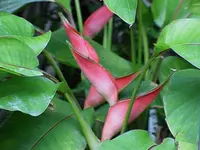
Fire bird (Heliconia stricta) is a tropical rhizomatous perennial valued for its bold foliage and striking, upright flower bracts in red, orange, or yellow tones. It forms dense clumps with lush, paddle-shaped leaves that give a strong jungle look, even in small gardens or containers.
This species is native to Central and South American rainforests, where it grows in warm, humid, partially shaded habitats. In cultivation, it prefers bright filtered light, consistently moist but well-drained soil, and protection from cold. With stable warmth and humidity, it is relatively straightforward to care for Fire Bird in suitable indoor or greenhouse conditions.

Care Difficulty
Moderate Care

Light Preference
Partial Sun

Water Requirements
Keep Soil Moist

Temperature Preference
Tropical / Frost Sensitive

Hardiness Zone
10–13

Soil Texture
Loamy, Silty, Organic-rich

Soil pH
Acidic (5.5–6.5), Slightly acidic (6.5–7.0)

Soil Drainage
Moist but well-drained

Fertilization
Moderate (every 2–4 weeks)
Scan your plant to receive care tips personalized for your specific plant
Available on iOS and Android
Heliconia stricta performs best in bright, warm, tropical-style light conditions.
Heliconia stricta needs steadily moist but not waterlogged soil.
This tropical species thrives in warm, frost-free conditions year-round.
This species prefers consistently high humidity for healthy foliage and flowering.
Heliconia stricta needs moisture-retentive yet well-aerated soil to support its vigorous growth.
This species can grow successfully in large containers when given adequate root space and stability.
Heliconia stricta is a fast-growing tropical that benefits from consistent, moderate feeding during the warm growing season.
Heliconia stricta responds well to light, targeted pruning that keeps clumps clean and flowering well.
Container-grown heliconia eventually become rootbound and benefit from periodic repotting or division.
Heliconia stricta is most reliably propagated by division of rhizomes rather than by seed.
This tropical species has low frost tolerance and requires protection in regions with cool or freezing winters.

Plant Health Check
Not sure what's wrong with your plant? Check your plant's health inside the app.
In its native range, this species is pollinated mainly by hermit hummingbirds whose long, curved bills match the shape of the inflorescence, making the plant highly dependent on these birds for successful seed set in the wild.
The showy red and yellow structures are bracts, while the actual flowers are small, tubular, and largely concealed inside, an arrangement that protects nectar and pollen from rain and non-pollinating visitors.
It forms dense rhizomatous clumps along stream banks and disturbed slopes in tropical South America, where its thick root and rhizome network helps stabilize moist soils and reduce erosion.

This species naturally colonizes light gaps and forest edges in lowland tropical rainforests, often forming nearly monospecific stands that significantly shape understory structure and provide long-lasting nectar resources for specialized hummingbirds and other nectar-feeding animals.
Lack of flowering usually results from insufficient light, cool temperatures, or inadequate nutrition. Ensure warm conditions, stable humidity, and a balanced fertilizer during active growth. Crowded clumps may also bloom less and benefit from periodic division.
Keep your plants happy and healthy with plant identification, disease detection, and easy care guidance.