Use host debris
Leave some intact, decaying oak leaves and small twigs on the soil surface, as this coarse litter supports the natural substrate structure that this fungus associates with in oak woodlands.

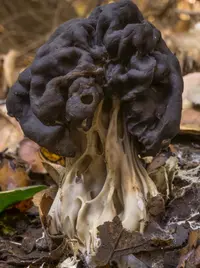
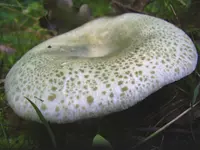
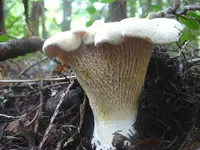
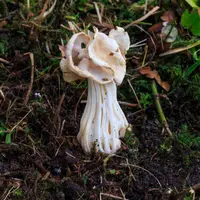
Oak-loving elfin saddle (Helvella dryophila) is a small woodland fungus, not a typical houseplant. It forms irregular, saddle-shaped caps in gray to brown shades on pale, ribbed stems. The fruiting bodies appear near oaks, usually on soil or among leaf litter, often in moist, cool seasons.
This species occurs mainly in temperate forests of North America and is tightly associated with oak roots. It can be challenging to cultivate because it depends on a mycorrhizal partnership, a nutrient-sharing relationship with tree roots. For most people, it is easier to observe than to care for Oak-loving Elfin Saddle, since it does best in stable, undisturbed woodland conditions with consistent moisture and well-drained soil rich in organic matter.

Care Difficulty
Hard Care

Light Preference
Partial Shade

Water Requirements
Regular Water

Temperature Preference
Cool Climate

Hardiness Zone
Unknown

Soil Texture
Loamy, Silty, Organic-rich

Soil pH
Acidic (5.5–6.5), Slightly acidic (6.5–7.0)

Soil Drainage
Moist but well-drained

Fertilization
Minimal (feed rarely)
Scan your plant to receive care tips personalized for your specific plant
Available on iOS and Android
This fungus prefers woodland light conditions beneath oak canopies rather than open, exposed sites.
Helvella dryophila depends on naturally moist but not saturated woodland soil rather than direct watering of the fungus itself.
This species fruits best in mild, temperate conditions typical of oak woodlands.
This ectomycorrhizal fungus prefers consistently moist, cool air typical of shaded woodland after rain.
This species depends on natural woodland soil conditions rather than conventional potting substrates.
This fungus is generally not suitable for container growing because it requires a living association with oak roots in undisturbed ground.
This mycorrhizal fungus grows with oak roots and usually does not need additional fertilizer in the ground.
Helvella dryophila does not respond to pruning like a typical garden plant and needs only minimal hygiene maintenance.
Oak-loving Elfin Saddle is typically left undisturbed, as it depends on a stable mycorrhizal partnership with oaks.
This fungus is not suited to standard home propagation methods and is usually left to spread naturally with its tree partners.
This species is cold hardy in its native range and generally requires no special winter care when growing in the ground with oaks.

Plant Health Check
Not sure what's wrong with your plant? Check your plant's health inside the app.
This species was described and distinguished from similar saddle fungi only in 2018, after detailed study of its microscopic features and DNA sequences clarified its status.
It fruits mainly under oaks in mixed or deciduous forests, reflecting a close ecological association with Quercus species implied by the name dryophila, which means oak-loving.
Unlike many saddle fungi that appear in late summer or autumn, this species typically fruits from spring into early summer in its native range along the Pacific coast of North America.

Molecular phylogenetic studies show that this species forms a distinct genetic lineage within the Helvella lacunosa group, helping mycologists refine species boundaries in a cluster of mushrooms that are otherwise very difficult to separate by appearance alone.
This fungus is generally regarded as inedible or at least not recommended for consumption. Related Helvella species can contain heat-stable toxins and cause gastrointestinal upset. For safety, it is best to avoid eating it altogether.
Keep your plants happy and healthy with plant identification, disease detection, and easy care guidance.