Host tree selection
Establish patches near compatible broadleaf hosts such as willow, birch, or oak in cool, moist sites, as this fungus relies on mycorrhizal association with tree roots rather than behaving like a typical standalone plant.

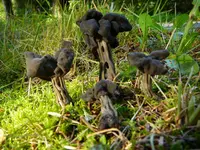
Elfin saddle (Helvella lacunosa) is a small, saddle-shaped fungus rather than a leafy plant. It forms gray to black, folded caps on slender, ridged stems. This species usually appears on soil or among leaf litter in forests, often near conifers or mixed woodland, in temperate regions of North America, Europe, and Asia.
It has a delicate, somewhat brittle structure and tends to fruit in small groups or scattered patches. Because it relies on complex relationships with soil and nearby trees, it is not easy to cultivate at home.
Those interested in how to care for Elfin Saddle should know it generally prefers cool conditions, moist but not waterlogged soil, and humus-rich forest substrates that are hard to recreate in containers.

Care Difficulty
Hard Care

Light Preference
Partial Shade

Water Requirements
Regular Water

Temperature Preference
Cool Climate

Hardiness Zone
5–9

Soil Texture
Loamy, Silty, Organic-rich

Soil pH
Acidic (5.5–6.5), Slightly acidic (6.5–7.0)

Soil Drainage
Moist but well-drained

Fertilization
Minimal (feed rarely)
Scan your plant to receive care tips personalized for your specific plant
Available on iOS and Android
This woodland fungus prefers low to moderate light that mimics a shaded forest floor.
This mycorrhizal fungus depends more on consistent soil moisture in its habitat than on direct watering.
This species fruits best in cool to mild conditions typical of temperate forests.
Humidity is of minor importance for Helvella lacunosa compared with moisture in the soil or substrate.
Helvella lacunosa develops best in loose, humus-rich, well-aerated soil that mimics a cool forest floor.
This species is not suitable for typical container growing and is rarely maintained successfully in pots.
This woodland fungus does not need routine fertilization and usually grows best in nutrient-balanced, undisturbed soil when caring for Elfin Saddle.
Helvella lacunosa does not require structured pruning, only simple cleanup of fruiting bodies.
This species is seldom grown in containers and is best left undisturbed in the ground.
Successful home propagation of this fungus is difficult and rarely attempted.
This species is naturally cold hardy in its native range and needs no special winter care.

Plant Health Check
Not sure what's wrong with your plant? Check your plant's health inside the app.
This fungus forms deeply ribbed and chambered stems, a feature that helps distinguish it from other saddle fungi and is reflected in its common name, elfin saddle.
The cap surface is usually dark gray to black and often irregularly folded, which has led to its frequent presence in studies of melanized, or darkly pigmented, fungal tissues.
Populations often increase after forest fires or in disturbed, ashy soils, and it is frequently recorded in surveys of post-fire fungal communities in temperate forests.

Helvella lacunosa has a long history of taxonomic confusion, and molecular (DNA-based) studies have shown that collections once identified under this single name in Europe, North America, and Asia actually represent several distinct but similar-looking species, leading to ongoing revisions of its species limits and distribution.
This fungus is sometimes eaten after thorough cooking, but identification is difficult and some related species contain toxins. Many experts advise against foraging or consumption unless guided by a skilled mycologist familiar with local look-alikes.
Keep your plants happy and healthy with plant identification, disease detection, and easy care guidance.