Retain Moist Microhabitat
Leave a thin layer of short moss, leaf litter, or fine bark on the soil surface to help keep the fruiting area evenly moist while still allowing good air flow around developing caps.

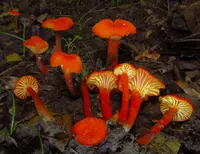
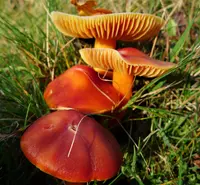
Goblet waxcap (Hygrocybe cantharellus) is a small, grassland mushroom known for its bright orange to reddish, goblet-shaped caps and slender stems. It is not a typical houseplant but a wild fungus that appears mainly in unimproved meadows and lawns.
This species is associated with low-nutrient, often mossy turf and is sensitive to disturbance, fertilization, and soil compaction. Because it relies on specific soil and habitat conditions, it is difficult to cultivate deliberately, and attempts to care for Goblet Waxcap at home are usually unsuccessful.
In nature, it favors cool, moist seasons, short grass, and clean, low-chemical soils, and often serves as an indicator of long-established grassland ecosystems.

Care Difficulty
Hard Care

Light Preference
Partial Shade

Water Requirements
Keep Soil Moist

Temperature Preference
Cool Climate

Hardiness Zone
5–9

Soil Texture
Loamy, Peaty, Organic-rich

Soil pH
Strongly acidic (4.5–5.5), Acidic (5.5–6.5)

Soil Drainage
Moist but well-drained

Fertilization
Minimal (feed rarely)
Scan your plant to receive care tips personalized for your specific plant
Available on iOS and Android
This grassland fungus prefers cool, moist conditions with gentle light rather than strong sun.
This species depends on consistently moist but not saturated grassland rather than direct watering of the fruiting bodies.
This waxcap fruits best in cool to mild conditions typical of autumn grasslands.
This fungus prefers consistently moist air and substrate, as it naturally grows in humid grassland or mossy habitats.
This species fruits best in moist, aerated, low-nutrient soil that mimics undisturbed grassland.
This waxcap is generally unsuitable for container growing because it depends on complex grassland soil communities that are hard to reproduce in pots.
Hygrocybe cantharellus is a woodland fungus that relies on natural soil nutrients and normally should not receive added fertilizer.
This mushroom does not require conventional pruning, since the visible fruiting bodies are temporary structures.
Goblet Waxcap is rarely grown in containers; focus on maintaining a stable, undisturbed outdoor habitat instead of repotting.
Propagation of Hygrocybe cantharellus is challenging and usually left to natural spore dispersal and habitat conservation rather than active techniques.
This waxcap is naturally cold hardy in suitable climates and usually needs no special winter care.

Plant Health Check
Not sure what's wrong with your plant? Check your plant's health inside the app.
This species produces small, bright orange to reddish-orange caps that have a distinctly waxy surface, a defining feature of many waxcap fungi but with a particularly vivid, goblet-like shape in this species.
Hygrocybe cantharellus is typically found in unimproved, low-fertility grasslands, especially in mossy, short turf, and is considered an indicator of relatively undisturbed, species-rich grassland ecosystems in some regions.
Although not common, this fungus has a broad but patchy distribution, recorded from parts of North America, Europe, and Asia, usually in cool to temperate climates and often fruiting in late summer to autumn.
This species is generally regarded as inedible. It is small, fragile, and offers little culinary value, and identification can be difficult. For safety, it is best not to collect or eat it.
Keep your plants happy and healthy with plant identification, disease detection, and easy care guidance.