Fan-shaped spacing
Plant and divide clumps so that individual fans face outward in a roughly circular pattern, which improves light penetration and airflow to reduce foliar disease and encourage even flowering.

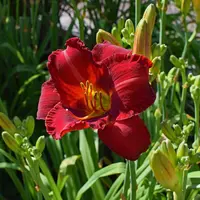
Hemerocallis 'Charles Johnston' is a herbaceous perennial daylily grown mainly for its large, rich red, trumpet-shaped flowers. Plants form dense, arching clumps of strappy green leaves that provide a tidy, low mound even when not in bloom.
This cultivar was bred from Asiatic species but is now common in gardens across temperate regions. It is valued for strong flowering performance, dependable hardiness, and ability to adapt to many soils.
The plant suits borders, mass plantings, and low-maintenance landscapes. It responds well to full sun, moderately moist but drained soil, and benefits from basic how to care for Daylily knowledge.

Care Difficulty
Easy Care

Light Preference
Full Sun

Water Requirements
Moderate Water

Temperature Preference
Cold Hardy

Hardiness Zone
3–9

Soil Texture
Sandy, Loamy, Clay

Soil pH
Acidic (5.5–6.5), Slightly acidic (6.5–7.0)

Soil Drainage
Moist but well-drained

Fertilization
Light (every 4–6 weeks)
Scan your plant to receive care tips personalized for your specific plant
Available on iOS and Android
This cultivar performs best in full sun but tolerates some light shade, especially in hotter regions.
This plant prefers evenly moist, well-drained soil rather than constant saturation.
This hardy perennial tolerates a wide temperature range but flowers best within a moderate growing window.
Humidity is not a significant factor for this hardy perennial.
Soil preparation should support deep roots, drainage, and consistent moisture retention.
This daylily adapts well to container growing outdoors when the pot is chosen carefully.
This cultivar benefits from light, consistent feeding during the active growing season to support flowering.
Pruning focuses on keeping Hemerocallis 'Charles Johnston' tidy and directing energy into new blooms.
This daylily is usually grown in the ground and benefits from occasional lifting and division rather than frequent repotting.
Propagation of this cultivar is most reliable through division of established clumps.
This hardy perennial usually needs minimal winter care in most temperate climates.

Plant Health Check
Not sure what's wrong with your plant? Check your plant's health inside the app.
This cultivar produces 10–12 cm, deep ruby-red flowers with a small golden throat and has received the American Hemerocallis Society Award of Merit for its strong garden performance and distinctive coloration.
Unlike many older daylilies that flower in a short flush, this cultivar is known to rebloom in suitable climates, producing several waves of flowers from mid to late summer rather than a single brief display.
Bred by daylily hybridizer F. M. Joiner and introduced in the 1970s, this plant was selected from complex hybrid crosses to combine a compact habit, strong red pigmentation, and reliable reblooming capacity.
Lack of flowers usually comes from too little light, overcrowded clumps, or nutrient imbalance. Older clumps often need dividing every 3–5 years. Avoid high‑nitrogen fertilizer and make sure plants are not shaded by shrubs or trees.
Keep your plants happy and healthy with plant identification, disease detection, and easy care guidance.