Sandier edge strip
When planting along paths or beds, leave a 10–15 cm wide strip of extra-sandy, well-drained soil at the outer edge so stems can sprawl and root lightly, which stabilizes the plant in windy, coastal-style sites.

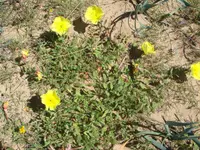
Beach evening primrose (Oenothera drummondii) is a low, spreading perennial often grown as a groundcover in warm coastal regions. It forms dense mats of green foliage that help stabilize sandy soils.
The plant produces bright yellow, cup-shaped flowers that open in the evening and fade by the next day, attracting night-flying pollinators. Stems are usually prostrate, allowing it to tolerate wind and salt spray along shorelines.
Native to coastal areas of the southern United States and Mexico, it is adapted to poor, sandy, well-drained soils and dry conditions. These stress-tolerant traits generally make it easy to grow, and learning how to care for beach evening primrose mainly involves providing sun and avoiding constantly wet soil.

Care Difficulty
Easy Care

Light Preference
Full Sun

Water Requirements
Low Water

Temperature Preference
Warm Climate

Hardiness Zone
8–11

Soil Texture
Sandy, Loamy, Rocky

Soil pH
Slightly acidic (6.5–7.0), Neutral (7.0)

Soil Drainage
Well-drained

Fertilization
Minimal (feed rarely)
Scan your plant to receive care tips personalized for your specific plant
Available on iOS and Android
This coastal perennial thrives in strong light and is adapted to open, exposed sites.
This species prefers dry to moderately dry conditions and is adapted to sandy, fast-draining soils.
This dune-adapted perennial handles heat well but is sensitive to hard frost, especially when young.
Humidity is rarely a concern for Oenothera drummondii, which is adapted to dry coastal air.
This coastal species prefers fast-draining, sandy substrates that do not stay wet.
This species can be grown in containers if its need for fast drainage and root space is respected.
This coastal perennial tolerates poor soils and usually needs only light feeding for healthy growth.
Pruning Oenothera drummondii keeps plants compact and encourages prolonged flowering.
This species is usually grown in-ground, so focus on careful transplanting rather than frequent repotting.
Oenothera drummondii is most often propagated from seeds, with division as a secondary option.
This coastal perennial is fairly cold tolerant in mild climates and usually needs minimal winter care.

Plant Health Check
Not sure what's wrong with your plant? Check your plant's health inside the app.
The yellow flowers open in the evening and close by the next day, a timing that suits nocturnal moth pollinators in its native Gulf Coast and Atlantic coastal habitats.
This species is a pioneer plant of sandy beaches, with flexible stems and a spreading habit that allow it to tolerate burial and movement of sand on coastal dunes.
Its thick, somewhat leathery leaves and deep, branching root system help it cope with salt spray, high light, and prolonged dry periods along seashores.

The extensive root system of this species helps stabilize sandy shorelines, so local conservation projects sometimes encourage its presence to reduce dune erosion without using artificial structures.
This species spreads laterally by rooting stems and self-seeding, especially in sandy, open sites. It can form dense mats, so in small gardens it is best to edge beds and remove unwanted seedlings regularly.
Keep your plants happy and healthy with plant identification, disease detection, and easy care guidance.