Rot-avoidance hygiene
Remove spent fruiting bodies and any slimy, decomposing mushroom tissue promptly to reduce bacterial growth and secondary mold that can collapse future flushes when caring for Hemistropharia.

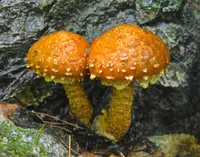
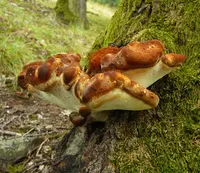
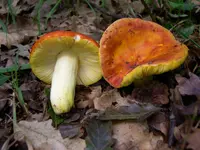
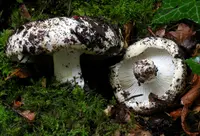
Hemistropharia albocrenulata is a wood-decaying fungus, not a typical houseplant. It forms medium to large, brownish caps with pale, scalloped margins and a ringed stem. The cap surface often shows fine scales, especially toward the center.
This species usually grows on dead or weakened hardwoods in temperate forests of Europe and North America. It plays a role in breaking down wood and recycling nutrients.
Because it is a wild mushroom with uncertain edibility, it is not recommended for home cultivation or consumption. Anyone wanting to learn how to care for Hemistropharia should focus on understanding its natural woodland habitat rather than treating it as a conventional ornamental plant.

Care Difficulty
Moderate Care

Light Preference
Partial Shade

Water Requirements
Keep Soil Moist

Temperature Preference
Cool Climate

Hardiness Zone
Unknown

Soil Texture
Loamy, Organic-rich

Soil pH
Acidic (5.5–6.5), Slightly acidic (6.5–7.0)

Soil Drainage
Moist but well-drained

Fertilization
Minimal (feed rarely)
Scan your plant to receive care tips personalized for your specific plant
Available on iOS and Android
This wood-rotting fungus prefers cool, moist, dappled woodland light rather than strong direct sun.
This fungus needs consistently moist, but not waterlogged, wood or woody mulch to fruit reliably.
This species fruits best in cool to mild conditions with distinct seasonal shifts.
This wood-decay mushroom prefers evenly moist, cool air rather than very dry conditions.
Hemistropharia albocrenulata grows best in loose, organic-rich substrate that mimics decomposing wood and forest litter.
This species can be grown in containers if its wood-based substrate and moisture needs are carefully managed.
This wood-decaying fungus is adapted to low-nutrient forest substrates and usually does not need intentional feeding in gardens or culture.
Pruning is not a standard practice for Hemistropharia albocrenulata, which is a short-lived fruiting fungus rather than a woody or leafy plant.
This species is not maintained as a conventional potted plant; management focuses on its woody substrate rather than repotting.
Propagation of this fungus is specialized and not commonly attempted by general gardeners, so routine home methods are limited.
In temperate climates this saprophytic fungus is naturally cold hardy and usually needs no deliberate winter care.

Plant Health Check
Not sure what's wrong with your plant? Check your plant's health inside the app.
This species develops a distinct, jagged-edged ring (annulus) on its stem, with small tooth-like projections that gave rise to its former genus name, Stropharia, and later helped define Hemistropharia as a separate group.
It grows on dead or decaying hardwood, especially aspen and other broadleaf trees, where it breaks down lignin-rich wood and contributes to nutrient recycling in temperate forests of Europe and North America.
Long known under various names in Stropharia, this fungus was moved to the genus Hemistropharia after microscopic and molecular studies showed that its spore and tissue structures differ significantly from true Stropharia species.
This mushroom is considered inedible or at least not recommended for consumption. Identification is difficult, and it may be confused with toxic species. For safety, it should be treated as non-edible and left unharvested.
Keep your plants happy and healthy with plant identification, disease detection, and easy care guidance.