Coral Bells Care (Heuchera villosa 'Citronelle')

About Coral Bells

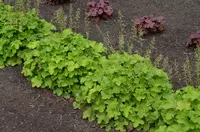
Coral bells Heuchera villosa 'Citronelle' is a compact, clump-forming perennial grown mainly for its bright chartreuse to lime-green foliage. Leaves form a dense mound, while slender flower stalks rise above with small bell-shaped blooms that attract pollinators.

This cultivar comes from a species native to rocky, woodland slopes in eastern North America, so it is naturally adapted to partial shade and well-drained soils. Its sturdy leaves and good heat tolerance make it easier to grow than many other light-leaved heucheras.

It suits borders, shaded containers, and mixed plantings where consistent foliage color is desired. Gardeners who want to learn how to care for Coral Bells often choose 'Citronelle' for its reliable performance and relatively low maintenance needs.

Main Plant Requirements

Care Difficulty

Moderate Care

Light Preference

Partial Shade

Water Requirements

Moderate Water

Temperature Preference

Cold Hardy

Hardiness Zone

4–9

Soil Texture

Loamy, Sandy, Organic-rich

Soil pH

Acidic (5.5–6.5), Slightly acidic (6.5–7.0)

Soil Drainage

Moist but well-drained

Fertilization

Light (every 4–6 weeks)

Get Personalized Care Plan

Scan your plant to receive care tips personalized for your specific plant

Available on iOS and Android

How to Care for the Coral Bells

Heuchera villosa 'Citronelle' prefers bright, gentle light that protects its foliage color and texture.

  • Provide 3–5 hours of morning sun with light or dappled shade from late morning through afternoon, especially in USDA zones 7–9.
  • In hot summers, protect Coral Bells from harsh afternoon sun to prevent leaf scorch and fading; use shade from trees, fences, or taller perennials.
  • In cooler climates, choose a site with partial shade to light shade; monitor foliage, as pale, leggy growth signals too little light, while crisp edges indicate too much sun.

Heuchera villosa 'Citronelle' needs consistently moist but not saturated soil to maintain healthy foliage.

  • Water when the top 2–4 cm of soil feels dry, aiming for deep soaking rather than frequent light splashes, especially in the first growing season.
  • Use well-drained, humus-rich soil; persistent soggy conditions, yellowing leaves, or crown softness indicate overwatering and risk of root or crown rot.
  • In summer heat, check soil more often and mulch 3–5 cm deep; in cool or rainy seasons, reduce watering and allow the surface to dry slightly between waterings.

This cultivar grows best in moderate temperatures and tolerates winter cold once established.

  • Optimal active growth occurs around 60–75°F (16–24°C); foliage color and vigor are strongest in these mild conditions.
  • Heuchera villosa 'Citronelle' is hardy to about -20°F (-29°C) in-ground with mulch; sudden freeze–thaw cycles can heave roots, so gently firm soil in early spring.
  • In summer, plants tolerate short periods up to 85–90°F (29–32°C) if soil stays evenly moist and roots are shaded; extended extreme heat can stress foliage and reduce vigor.

This plant manages well in typical outdoor humidity but benefits from moderately moist air in hot regions.

  • Target ambient humidity around 40–60% in containers, especially on exposed patios or balconies.
  • It tolerates drier air but prolonged hot, dry winds can cause leaf edges to brown and curl.
  • Increase humidity by grouping pots, adding a gravel tray under containers, or positioning Coral Bells near other dense plantings to slow evaporation.

Heuchera villosa 'Citronelle' prefers loose, moisture-retentive but well-drained soil with ample organic matter.

  • Use a loamy mix with roughly 40–50% compost, 30–40% garden loam, and 10–20% perlite or pine bark fines for structure and aeration.
  • Aim for slightly acidic to neutral pH, around 6.0–7.0, to support nutrient availability and root health.
  • Improve drainage in heavy clay by incorporating coarse sand or fine gravel plus organic matter through the top 15–20 cm.
  • Avoid compacted, waterlogged, or pure sand soils, which either suffocate roots or dry out too rapidly and stress the foliage.

This species is well suited to container growing on patios, balconies, and shaded entries.

  • Choose a wide, relatively shallow pot to match its fibrous, surface-rooted system and keep the crown slightly above the soil line.
  • Use a heavier or weighted container in windy sites so the leafy mound does not tip over when foliage is fully developed.
  • Select pot materials with moderate moisture retention, such as glazed ceramic or thick plastic, to prevent rapid drying in summer heat.

Heuchera villosa 'Citronelle' benefits from modest feeding to support foliage color and steady growth.

  • Apply a balanced, slow-release fertilizer (around 10-10-10) in early spring at half the label rate, scratched lightly into the soil surface.
  • Supplement with a thin layer of compost once a year to improve soil structure and nutrient availability for Coral Bells.
  • During the growing season, avoid additional high-nitrogen products that can cause weak, floppy leaves and reduce color intensity.
  • Stop feeding in late summer and do not fertilize in winter, when growth naturally slows or pauses.

Pruning Heuchera villosa 'Citronelle' is light and mainly focused on keeping the clump tidy and healthy.

  • In early spring, remove all dead, winter-burned, or mushy leaves at the base using clean, sharp scissors or hand pruners.
  • Through the growing season, trim off faded flower stalks to direct energy back into foliage and encourage a neater mound.
  • Cut out damaged or crowded leaves to improve air movement and reduce the risk of fungal problems at the crown.
  • Every few years, lightly tidy long, woody stems by trimming them back to fresh growth to maintain a compact shape.

Transplanting or repotting is infrequent and mainly needed when clumps become crowded or container roots are tight.

  • Plan major transplanting for early spring or early fall, when temperatures are mild and soil moisture is steady.
  • Look for signs such as roots circling the pot, soil drying very fast, or slowed growth before moving the plant.
  • Every 3–4 years, lift garden clumps, divide if needed, and replant crowns at soil level in well-drained, enriched soil.
  • Reduce root stress by watering the plant well before and after moving, handling roots gently, and shading it for a few days if conditions are bright.

Propagation of Heuchera villosa 'Citronelle' is commonly done by division to keep desirable foliage traits.

  • Divide mature clumps in early spring or early fall, when temperatures are cool and plants are not in peak stress.
  • Lift the plant, gently shake off soil, and split it into sections, each with several shoots and healthy roots.
  • Replant divisions at the same depth in well-drained soil, spacing them to allow air flow around the crowns.
  • Water thoroughly after planting and keep soil evenly moist, not waterlogged, until new growth shows strong establishment.

Winter care needs are modest because this cultivar is broadly cold hardy in typical garden conditions.

  • In cold climates, apply a 5–7 cm layer of mulch around, but not over, the crown to insulate the root zone.
  • Leave healthy foliage in place until late winter, then remove only what is truly dead or mushy.
  • For containers in zones with repeated hard freezes, move pots into a sheltered, unheated but frost-moderated area.

Care Tips

Divide Aging Clumps

Every 3–4 years, lift and divide crowded plants in early spring or early fall to refresh vigor and maintain dense foliage mounds.

Lift Heaving Crowns

In regions with freeze–thaw cycles, check in late winter for crowns pushed above the soil and gently replant them at the original level to prevent root desiccation and loss.

Use Light-Colored Mulch

Apply a 2–3 in layer of pale, fine-textured mulch around but not touching the crown to keep roots cool and reduce leaf scorch on the chartreuse foliage.

Edge Protection From Lawns

Install a shallow physical edging strip between turf and planting areas to prevent string trimmer or mower damage to the soft leaf stems.

Monitor Foliage Renewal

In late winter, trim away only the oldest, tattered leaves and leave the firm new ones so the plant can photosynthesize strongly as it starts growing Coral Bells for the new season.

Common Pests and Diseases

Black vine weevil

This pest feeds on the roots as larvae and notches leaf edges as adults, often causing wilting and decline in heucheras, especially in containers and shaded beds.

Solution

Inspect foliage at night for adult beetles, hand-pick where possible, and remove heavily infested plants. For larvae in the soil, use beneficial nematodes (Heterorhabditis or Steinernema species) in spring or late summer and avoid letting containers stay constantly wet, which favors larval survival.

Rust

This disease causes small orange, brown, or rust-colored pustules on leaf undersides and yellowing or spotting on upper surfaces, leading to premature leaf drop.

Solution

Remove and discard affected leaves promptly and avoid overhead watering so foliage dries quickly. Improve spacing and airflow, water at soil level, and if rust persists, use a labeled ornamental fungicide applied according to Coral Bells care instructions and local regulations.

Leaf spot

This disease produces round to irregular water-soaked or dark spots on leaves that may expand, coalesce, and cause sections of tissue to die.

Solution

Cut off and discard spotted leaves to reduce inoculum, sanitize tools, and keep foliage dry by watering early in the day at the base of the plant. In chronic cases, improve drainage and airflow, and consider a targeted ornamental fungicide labeled for leaf spots on perennials.

Powdery mildew

This disease appears as white to gray powdery patches on the upper leaf surface, which can lead to leaf distortion and reduced vigor in humid, shaded sites.

Solution

Increase light and airflow by thinning surrounding plants and avoid crowding clumps. Remove the most affected leaves and, if needed during prolonged humid periods, apply a sulfur or potassium bicarbonate-based fungicide labeled for powdery mildew on ornamentals.

Aphids

These insects cluster on young stems and leaf undersides, sucking sap and causing curling, distortion, and sticky honeydew that can attract sooty mold.

Solution

Rinse colonies off with a strong stream of water and repeat as needed, or use insecticidal soap or a light horticultural oil, ensuring full coverage of leaf undersides. Encourage natural predators such as lady beetles by avoiding broad-spectrum insecticides in the surrounding garden.

Interesting Facts

Villosa parentage advantage

This cultivar was bred from Heuchera villosa, a species native to rocky outcrops and ledges in the eastern United States, which gives it better tolerance of heat and humidity than many other coral bells.

Stable lime foliage

Its unusually bright chartreuse to lime foliage holds color through summer heat in partial shade, whereas many other lime heucheras quickly fade or scorch under similar conditions.

Compact clumping habit

The plant forms a dense, low mound rather than a loose or sprawling rosette, a trait selected specifically to maintain a neat, uniform appearance in borders and containers over several seasons.

Botan icon

Did you know?

Heuchera villosa 'Citronelle' is one of the few lime-colored heuchera cultivars that can maintain both vivid foliage color and relatively good leaf substance in the warm, humid summer conditions typical of much of the eastern United States, which led to its rapid adoption in professional shade garden designs.

FAQs about Coral Bells

Brown leaf edges usually result from drought stress, excess sun, or fertilizer burn. Check soil moisture, reduce direct afternoon sun, and avoid overfertilizing. Remove worst leaves; new growth will show whether conditions have improved.

Grow Healthy Plants with Botan Care

Keep your plants happy and healthy with plant identification, disease detection, and easy care guidance.

Botan plant care app — identify plants on mobile

Explore More Plants