Veitch's Masdevallia Care (Masdevallia veitchiana)

Also known as: Veitch's Marvel
Veitch's Masdevallia

About Veitch's Masdevallia

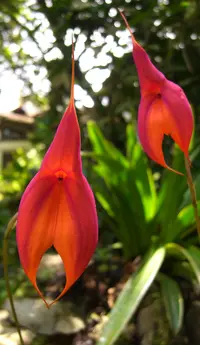
Masdevallia veitchiana, commonly called Veitch's Masdevallia or the king of the masdevallias, is a compact epiphytic orchid known for its vivid orange to reddish triangular flowers. The blooms often have shimmering, iridescent surfaces and long tail-like sepal tips, giving the plant a striking, architectural look.

This species comes from cool, moist, high-elevation cloud forests in Peru, where it grows on rocks or trees in bright, filtered light and constant humidity. Because it dislikes heat, dryness, and stagnant conditions, it is considered moderately challenging and suits growers who can provide stable, cool, moist air. Learning how to care for Veitch's Masdevallia helps prevent stress and keeps this orchid blooming reliably indoors or in a controlled greenhouse setup.

Main Plant Requirements

Care Difficulty

Hard Care

Light Preference

Bright Indirect Light

Water Requirements

Keep Soil Moist

Temperature Preference

Cool Climate

Hardiness Zone

Unknown

Soil Texture

Peaty, Organic-rich

Soil pH

Acidic (5.5–6.5)

Soil Drainage

Moist but well-drained

Fertilization

Light (every 4–6 weeks)

Get Personalized Care Plan

Scan your plant to receive care tips personalized for your specific plant

Available on iOS and Android

How to Care for the Veitch's Masdevallia

This cool-growing orchid needs bright, indirect light with careful protection from strong sun.

  • Provide 6–8 hours of bright, filtered light each day, such as under 30–50% shade cloth outdoors or behind a sheer curtain indoors.
  • Allow gentle early morning sun but avoid direct midday and afternoon sun, which can scorch leaves and wash out the orange color of Veitch's Masdevallia.
  • In winter, move the plant to a brighter position, but keep light diffused; pale, elongated leaves indicate insufficient light.

This orchid prefers consistently moist conditions without staying waterlogged.

  • Keep the potting mix or mount evenly moist, allowing only the top 0.5–1 cm to approach dryness before watering again.
  • Increase watering in warm, bright periods and reduce slightly in cooler months, but do not let Masdevallia veitchiana dry out completely.
  • Watch for limp, wrinkled leaves as a sign of underwatering, and for blackened roots or a sour smell as signs of overwatering and poor drainage.

This species thrives in cool to intermediate temperatures and reacts quickly to extremes.

  • Aim for 55–70°F (13–21°C) most of the year, with slight night drops; short spikes to 75°F (24°C) are usually tolerated with high humidity and airflow.
  • Avoid temperatures below 40°F (4°C); even short exposure near freezing can damage leaves and buds and should be prevented.
  • Protect from prolonged heat above 80°F (27°C) by increasing shade, air movement, and humidity, and reduce fertilizer until cooler conditions return.

This orchid needs consistently high humidity to maintain healthy leaves and flowers.

  • Aim for 70–90% humidity, as Veitch's Masdevallia comes from cool, cloud forest conditions.
  • Dry indoor air below 50% causes leaf edge browning, limp foliage, and bud drop.
  • Increase humidity with a room humidifier, grouped plants, and a pebble tray, but keep leaves in moving air to prevent fungal problems.

This epiphytic orchid prefers a loose, airy, fast-draining medium rather than regular potting soil.

  • Use a fine to medium orchid mix of fir bark, sphagnum moss, and perlite to hold moisture while allowing strong aeration.
  • Aim for slightly acidic conditions, roughly pH 5.5–6.5, which support nutrient uptake in Masdevallia veitchiana.
  • Ensure water drains through in seconds; standing water around roots quickly leads to rot and loss of fine root tips.
  • Avoid dense, peat-heavy or garden soils that compact around roots and restrict oxygen flow.

This species is well suited to container growing when moisture and aeration are carefully balanced.

  • Choose a relatively shallow pot that matches the compact root system, limiting excess wet medium that stays cold and soggy.
  • Use slotted or net orchid pots inside a cachepot to boost side aeration while still managing drips on shelves or benches.
  • Select plastic pots if fast drying is a problem, or clay pots in very humid areas to prevent the medium from staying overly wet.

This cool-growing orchid benefits from light, consistent feeding during its active season.

  • Use a balanced orchid fertilizer (around 20-20-20) diluted to 1/4–1/2 strength in low-mineral water.
  • Feed Veitch's Masdevallia every 2–3 weeks in spring and summer, skipping one watering between feeds.
  • Reduce feeding to 1× month in fall and winter, or pause if growth slows markedly.
  • Flush the pot with plain water monthly to prevent fertilizer salt buildup around the roots.

Pruning needs for Masdevallia veitchiana focus on hygiene rather than shaping.

  • After flowers fade, cut spent flower spikes at the base with clean, sharp scissors or snips.
  • Remove yellow, dead, or damaged leaves at their base to limit fungal and bacterial problems.
  • Trim only clearly unhealthy tissue; avoid cutting healthy leaves or pseudobase areas to prevent stress.
  • Inspect plants every few weeks year-round, doing small sanitary trims instead of major pruning sessions.

This orchid prefers tight quarters but needs periodic repotting to maintain fresh, airy media.

  • Repot every 1–2 years, or when roots circle the pot, growth slows, or the medium breaks down and stays soggy.
  • Plan repotting for late winter to early spring, just before active growth begins for Masdevallia veitchiana.
  • Gently tease roots free, remove decomposed bark, and trim only clearly dead roots with sterile scissors.
  • Replant in a small, well-drained pot with fine orchid bark and sphagnum, then keep slightly drier for 7–10 days.

Propagation of this species is usually done by careful division of mature clumps.

  • Divide Masdevallia veitchiana in late winter or early spring, ideally when repotting a healthy, vigorous plant.
  • Choose sections with at least 3–5 growths and a good root system to ensure stable establishment.
  • Use sterile tools to separate the clump, then dust cut surfaces lightly with powdered sulfur or cinnamon.
  • Pot divisions in fine, moist, airy orchid mix and maintain high humidity, bright shade, and stable 55–75°F temperatures.

Cool but frost-free winter conditions are crucial for this cloud-forest orchid.

  • Masdevallia veitchiana is not frost tolerant; maintain indoor or greenhouse temperatures above 45°F.
  • In cold regions, grow in pots and move indoors before nights drop below 50°F.
  • Keep bright, indirect light and good air movement while slightly reducing watering to avoid cold, wet roots.
  • Avoid placing plants near heating vents or very dry drafts; aim for 60–80% humidity with stable temperatures.

Care Tips

Mesh-pot setup

Use a plastic mesh pot nested inside a solid pot so roots get high airflow while the outer pot helps stabilize moisture, especially helpful when growing Veitch's Masdevallia in warm homes.

Cool-down microclimate

Place the plant on a wide evaporative tray and position a small fan on the lowest setting nearby to keep leaf temperatures a few degrees cooler during hot afternoons.

Gentle stake support

Use thin, smooth orchid stakes and soft clips to support tall inflorescences, positioning stakes early so developing spikes are guided upright without kinks or breakage.

Seasonal repot timing

Schedule repotting just as new root tips appear in late winter or early spring, so fresh roots can quickly colonize new medium and recover from disturbance.

Targeted pest checks

Inspect the undersides of leaves and the base of the pseudostems every 1–2 weeks with a magnifier, treating early signs of mites or aphids using a low-toxicity horticultural soap spray before populations build.

Common Pests and Diseases

Spider mites

This pest thrives in warm, dry air and can quickly desiccate the thin leaves, especially in bright conditions. Symptoms include fine webbing, stippled leaves, and dull, silvery leaf surfaces.

Solution

Increase humidity to 60–80%, rinse foliage with a gentle shower, and wipe leaves with a soft cloth to remove mites and webbing. Follow with repeated applications of insecticidal soap or horticultural oil on both leaf surfaces, and improve air movement without creating drafts, which is key for Masdevallia veitchiana care.

Slugs and snails

These insects feed on tender leaves, flowers, and developing spikes, especially in cool, damp conditions typical of shaded orchid benches. Symptoms include irregular holes, ragged edges, and slime trails on leaves and pots.

Solution

Hand-pick pests in the evening, use copper tape or physical barriers around benches, and reduce standing moisture under pots. In outdoor or greenhouse setups, place iron phosphate bait away from roots and refresh it regularly until new damage stops.

Bacterial brown spot

This disease is favored by cool temperatures combined with prolonged leaf wetness and poor air circulation. Symptoms include water-soaked lesions on leaves that turn brown to black, often with a yellow halo.

Solution

Remove and discard affected leaves with sterile tools, then improve airflow and avoid water sitting on foliage, especially at night. Keep the plant in its preferred cool, bright conditions but water early in the day, and disinfect benches and tools to limit spread.

Leaf tip burn

This disorder is associated with excess fertilizer salts, low-quality water, or sudden swings in moisture in the fine-rooted Masdevallia. Symptoms include browning and drying of leaf tips that can progress down the blade under continued stress.

Solution

Flush the pot thoroughly with low-mineral water (such as rainwater, distilled, or RO) and reduce fertilizer strength to 1⁄4–1⁄2 of the orchid label rate. Maintain evenly moist but airy medium, repot if the mix is decomposed or crusted with salts, and avoid letting the plant dry out completely between waterings.

Fungal leaf spot

This disease occurs when foliage stays wet in cool, still air, a common issue in tightly packed cool-growing orchid collections. Symptoms include small dark spots that may enlarge, coalesce, and develop yellow halos or dry, papery centers.

Solution

Remove spotted leaves that are more than lightly affected and dispose of them away from the growing area. Increase spacing and airflow, water at the base early in the day, and if new spots continue to appear, use a labeled orchid fungicide as a preventive spray according to the product instructions.

Interesting Facts

Native high Andean habitat

This orchid is naturally found on exposed rocky slopes in the central Peruvian Andes, often between roughly 2,000–4,000 m where days are bright and cool and nights drop sharply in temperature.

Iridescent orange petals

The vivid orange to coppery flowers often show a metallic, iridescent sheen caused by microscopic surface structures on the petals that scatter light, rather than by pigment alone.

Nectar guides for pollinators

The purple spotting and striping inside the flower act as visual nectar guides, helping native pollinators navigate toward the nectar and reproductive structures with high precision.

Botan icon

Did you know?

The species name veitchiana honors the 19th‑century Veitch Nurseries in England, which played a major role in introducing this Andean orchid to cultivation and to European horticulture.

FAQs about Veitch's Masdevallia

Lack of blooms usually results from temperatures that are too warm, stale air, or insufficient day–night temperature drop. Older, depleted potting mix and inadequate fertilization also reduce flowering. Provide cool, humid, well-ventilated conditions and repot regularly.

Grow Healthy Plants with Botan Care

Keep your plants happy and healthy with plant identification, disease detection, and easy care guidance.


Botan plant care app — identify plants on mobile

Explore More Plants