Select safe hosts
Establish this bracket fungus on already dead hardwood logs or stumps rather than on living trees to avoid unintended damage to landscape specimens when growing Hexagonia vesparia.

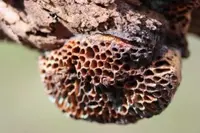
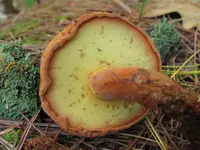
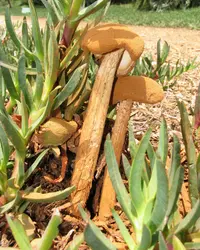
Hexagonia vesparia is a bracket fungus rather than a traditional leafy plant. It forms layered, woody shelves on dead or dying wood, often in overlapping clusters. The upper surface is usually yellowish to brown, while the underside shows fine pores instead of gills.
This species is widespread in tropical and subtropical forests, where it plays an important role in breaking down dead timber. It is not grown as a typical houseplant, but understanding how to care for Hexagonia vesparia helps when studying or managing it in outdoor collections. It generally prefers shaded, humid conditions and decaying wood with consistent moisture.

Care Difficulty
Moderate Care

Light Preference
Partial Shade

Water Requirements
Regular Water

Temperature Preference
Warm Climate

Hardiness Zone
Unknown

Soil Texture
Loamy, Silty, Organic-rich

Soil pH
Acidic (5.5–6.5)

Soil Drainage
Moist but well-drained

Fertilization
Minimal (feed rarely)
Scan your plant to receive care tips personalized for your specific plant
Available on iOS and Android
This bracket fungus prefers bright, indirect woodland-style light with protection from intense midday sun.
This wood-decaying fungus relies on stable moisture in its host substrate rather than direct watering on the fruiting bodies.
This species develops best in mild to warm conditions typical of temperate woodlands.
This bracket fungus does not require humidity control and tolerates typical outdoor fluctuations well.
This wood-decaying fungus grows on dead wood rather than true soil, but similar conditions can be mimicked in cultivation.
This species can be grown in containers when provided with suitable woody substrate instead of potting soil.
This wood-decaying bracket fungus grows on nutrient-rich dead wood and does not benefit from conventional fertilization.
This bracket fungus does not require horticultural pruning, as fruiting bodies naturally form and decay on dead wood.
In gardens or collections, Hexagonia vesparia is usually managed by moving colonized wood rather than by true repotting.
This species is not commonly propagated in home settings and is usually left to spread naturally on suitable dead wood.
Outdoors, this fungus is naturally cold hardy across much of its range and needs no special winter care.

Plant Health Check
Not sure what's wrong with your plant? Check your plant's health inside the app.
The pore surface of this bracket fungus is distinctly hexagonal and somewhat raised, giving it a wasp-nest appearance that inspired both its genus name and the epithet vesparia, which refers to wasps.
This species commonly colonizes dead or fire-damaged hardwoods, especially birch, playing a role in the decomposition and nutrient recycling of trees stressed or killed by wildfire or other disturbances.
Hexagonia vesparia occurs across temperate regions of Europe, Asia, and North America, typically in woodlands where it grows as overlapping clusters of thin, leathery brackets on fallen logs or stumps.

Molecular and morphological studies have shown that this species, long placed in the genus Hexagonia, is part of a complex group of polypores whose evolutionary relationships help mycologists understand how pore structures and wood-decaying strategies diversified in bracket fungi.
Yes, this bracket fungus can be cultivated on logs or hardwood blocks placed in large containers. The key is providing consistently moist, shaded conditions and good airflow so the woody fruiting bodies can develop without rotting or drying prematurely.
Keep your plants happy and healthy with plant identification, disease detection, and easy care guidance.