Stake Early
Install sturdy stakes or a wire support ring when shoots reach 30–45 cm so tall stems stay upright and are not damaged by wind or heavy rain later in the season.

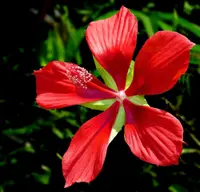
Texas star hibiscus, Hibiscus coccineus, is a hardy, deciduous perennial known for its large, star-shaped red flowers and tall, upright stems. It belongs to the mallow family and is often grown as a bold feature in garden beds or near ponds.
In nature, it occurs in wetlands and along streams in the southeastern United States, so it is adapted to warm climates and moist conditions. The plant prefers full sun, consistently damp soil, and good drainage, which makes it relatively straightforward to grow where water is available.
Understanding how to care for Texas Star hibiscus mainly involves providing enough light and moisture while allowing space for its tall, open growth habit.

Care Difficulty
Moderate Care

Light Preference
Full Sun

Water Requirements
Aquatic

Temperature Preference
Cold Hardy

Hardiness Zone
6–9

Soil Texture
Loamy, Silty, Organic-rich

Soil pH
Acidic (5.5–6.5), Slightly acidic (6.5–7.0)

Soil Drainage
Waterlogged tolerant

Fertilization
Light (every 4–6 weeks)
Scan your plant to receive care tips personalized for your specific plant
Available on iOS and Android
This sun-loving wetland perennial needs strong light to flower well outdoors.
This species prefers consistently moist to wet conditions, especially during active growth.
This hardy perennial handles summer heat but reacts poorly to hard frost on new growth.
This species tolerates a wide humidity range but grows best with moderately moist air.
Hibiscus coccineus prefers consistently moist, rich, slightly acidic soil with strong structure.
This species grows well in large containers if moisture and stability are managed carefully.
Hibiscus coccineus responds well to moderate feeding during its active growing season.
Thoughtful pruning keeps Hibiscus coccineus upright, flowering well, and tidy in the garden.
This species is usually grown in the ground, but container plants or young starts may need careful transplanting.
Hibiscus coccineus is commonly propagated by seed and by softwood or semi-ripe stem cuttings.
This hardy perennial dies back above ground in cold climates but usually needs only modest winter care.

Plant Health Check
Not sure what's wrong with your plant? Check your plant's health inside the app.
This species is naturally found in wetlands, swamp margins, and along streams in the southeastern United States, where its tall stems and deep roots tolerate seasonal flooding that would kill many garden perennials.
Individual flowers usually last only a single day, but the plant produces new blooms in succession over many weeks, a strategy that supports continuous pollinator visits during the warm season.
Unlike many tropical hibiscus, this species is herbaceous and dies back to the ground in winter, allowing its underground structures to survive frost and return reliably in spring in much cooler climates than most hibiscus tolerate.

The species has been studied as a potential ornamental crop for constructed wetlands and rain gardens because its showy flowers attract pollinators while the root system helps stabilize soil and tolerate nutrient-rich, periodically flooded conditions.
Lack of blooms usually comes from insufficient maturity, heavy shade, or low nutrients. Ensure it is established for at least 1–2 seasons, receives strong light, and gets balanced fertilizer without excessive nitrogen, which favors leaves over flowers.
Keep your plants happy and healthy with plant identification, disease detection, and easy care guidance.