Holcoglossum pumilum Care

Holcoglossum pumilum

About Holcoglossum pumilum

Holcoglossum pumilum is a miniature epiphytic orchid, usually growing on trees or rocks rather than in soil. It forms small clumps of narrow leaves and fine roots that cling tightly to its support.

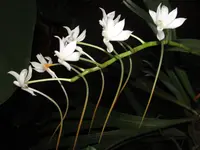
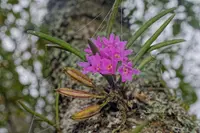
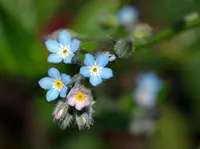
The plant is valued for its delicate, starry flowers, which appear on short, wiry stems and give a refined, airy look. It occurs naturally in parts of East and Southeast Asia, often in cool to mild, humid mountain habitats.

Because it is small and sensitive to drying out, it can be more challenging than common orchids and suits growers who can monitor moisture and airflow closely. Consistent bright filtered light, high humidity, and good air movement are key if you want to learn how to care for Holcoglossum pumilum.

Main Plant Requirements

Care Difficulty

Hard Care

Light Preference

Bright Indirect Light

Water Requirements

Keep Soil Moist

Temperature Preference

Tropical / Frost Sensitive

Hardiness Zone

Unknown

Soil Texture

Sandy, Rocky, Organic-rich

Soil pH

Acidic (5.5–6.5)

Soil Drainage

Well-drained

Fertilization

Light (every 4–6 weeks)

Get Personalized Care Plan

Scan your plant to receive care tips personalized for your specific plant

Available on iOS and Android

How to Care for the Holcoglossum pumilum

This small epiphytic orchid prefers bright, gentle light that mimics high, airy branches in nature.

  • Aim for 6–8 hours of bright, indirect light per day, with soft morning sun and protection from harsh midday and afternoon rays.
  • Provide dappled or filtered light under 30–50% shade cloth outdoors; leaves should stay medium green, not dark or yellowed.
  • In summer, move Holcoglossum pumilum slightly deeper into shade; in winter, give brighter exposure or a south- or east-facing position to compensate for weaker sun.

This orchid prefers frequent light moisture around the roots but needs fast drying between waterings.

  • Water when roots or mounting material feel just dry to the touch, often every 1–3 days in warm weather rather than on a fixed schedule.
  • Ensure excellent drainage; mounted plants or very open orchid mixes reduce the risk of root rot from standing water or constantly wet media.
  • Reduce watering in cooler months, watching for wrinkled leaves or shriveled roots as signs of underwatering and black, mushy roots as signs of overwatering in Holcoglossum pumilum.

This species prefers intermediate to warm conditions with a mild seasonal drop at night.

  • Target 65–80°F (18–27°C) by day for active growth, with nights around 55–65°F (13–18°C) to support healthy metabolism.
  • Protect from cold; growth slows below about 50°F (10°C), and prolonged exposure near 40°F (4°C) or any frost can cause leaf and root damage.
  • In hot spells above 85–90°F (29–32°C), increase air movement and humidity and avoid strong direct sun to limit heat stress and leaf scorch.

This miniature orchid prefers consistently high humidity to maintain healthy roots and foliage.

  • Aim for 60–80% humidity, as drier air below about 50% leads to shriveling roots and limp leaves.
  • Watch for browned leaf tips, wrinkled leaves, and stalled growth as signs of humidity stress.
  • Increase humidity with a nearby cool-mist humidifier, enclosed orchid case, or tight pebble tray placed directly under the plant.

This species is typically grown as an epiphyte in a very open, airy medium rather than traditional soil.

  • Use a fine to medium orchid mix based on bark and sphagnum moss, with added perlite to keep the structure loose and highly aerated.
  • Ensure extremely rapid drainage; water must run through in seconds, leaving the medium just slightly moist around the roots.
  • Keep pH slightly acidic to neutral, roughly 5.5–6.5, which supports nutrient availability for Holcoglossum pumilum.
  • Avoid dense peat, standard potting mix, or compacted media, which suffocate roots and encourage rot in this small epiphytic orchid.

This orchid is suitable for container culture in small, very well-ventilated pots or baskets.

  • Choose slotted or net-style orchid pots so roots receive maximum air movement while excess water drains instantly.
  • Select a container just large enough to fit the root system tightly, which keeps the open medium from staying wet for too long.
  • Use a lightweight hanging basket or secured pot if mounted-style growth makes the plant unbalanced in a standard container.

This small epiphytic orchid benefits from light, consistent feeding during its active growing season.

  • Use a balanced NPK orchid fertilizer diluted to 25–50% strength, applied to moist roots to avoid burn.
  • Feed every 2 weeks in spring and summer when Holcoglossum pumilum produces new roots and leaves.
  • Reduce feeding to 1× month in fall and stop or nearly stop in winter rest.
  • Avoid fertilizer buildup by flushing the medium with plain water every 3–4 weeks.

Pruning needs are minimal and focus mainly on hygiene and maintaining plant health.

  • Best time to prune is after flowering, when spent spikes have faded completely.
  • Remove dead, damaged, or desiccated roots and leaves with sterilized, sharp scissors or orchid snips.
  • Cut old, brown flower spikes at the base to direct energy into new vegetative growth and future blooms.
  • Avoid cutting firm, green roots or healthy leaves, as this can weaken Holcoglossum pumilum.

This species prefers stability and should be repotted or remounted only when clearly necessary.

  • Check for tight, circling roots, decomposed medium, or slowed growth as signs it needs repotting or fresh mounting.
  • Plan repotting in late winter to early spring, just before new root tips emerge for faster recovery.
  • Expect to repot or remount every 2–3 years, using a very open orchid mix or mounting on bark or cork.
  • Minimize root stress by soaking roots first, handling them gently, and keeping humidity high for several weeks afterward.

Propagation of this orchid is specialized and usually limited to experienced growers or professional labs.

  • Vegetative propagation relies on careful division of mature plants that show multiple, well-rooted growths.
  • Divide in late spring, ensuring each division has several healthy roots and at least one strong growth point.
  • Mount or pot divisions in a fine yet airy orchid medium, then maintain high humidity and bright, indirect light.
  • Seed propagation requires sterile in vitro culture and is not practical for home growers.

This orchid is not frost hardy and needs controlled indoor conditions during cold weather.

  • Maintain temperatures around 55–65°F at night and 65–75°F by day during winter months.
  • Grow Holcoglossum pumilum indoors or in a heated greenhouse where frost cannot reach leaves or roots.
  • Provide bright, indirect light and good air movement while slightly reducing watering to prevent rot.
  • Avoid placing plants near cold drafts or directly against cold window glass.

Care Tips

Mounting strategy

Mount plants on narrow, moisture-retentive but fast-drying slabs (such as cork with a thin layer of long-fiber sphagnum only at the roots) so the fine roots can grip firmly without staying wet for many hours.

Air movement tuning

Aim a small, oscillating fan so air flows gently past, not directly onto, the plant to keep roots dry between mistings while preventing desiccation of the delicate leaves and flowers.

Water quality control

Use low-mineral water (rainwater, distilled, or reverse-osmosis) and flush mounts thoroughly every 2–3 weeks to prevent fertilizer salts from burning the fine roots.

Seasonal rest adjustment

In late autumn reduce fertilizer to very weak levels and slightly lengthen the interval between waterings to mimic a cooler, drier rest without allowing the roots to become fully dry for long periods.

Bud protection practice

During spike and bud development, avoid drastic changes in light, temperature, or water routine and shield the plant from hot, dry drafts to reduce the risk of bud blast when caring for Holcoglossum pumilum.

Common Pests and Diseases

Scale insects

This pest attaches firmly to roots, leaves, and sheaths, sucking sap and weakening the compact plant, especially in warm, still air. Symptoms include yellowing leaves, sticky honeydew, and small brown or whitish bumps on roots or leaf bases.

Solution

Isolate the plant, then manually remove visible scale with a cotton swab dipped in isopropyl alcohol, paying special attention to root crowns and leaf axils. Improve air movement, avoid excess nitrogen fertilization, and use a horticultural oil or insecticidal soap labeled for orchids in repeated treatments to break the life cycle while monitoring closely as part of ongoing Holcoglossum pumilum care.

Spider mites

These insects thrive on Holcoglossum foliage grown in warm, dry conditions, feeding on undersides of leaves and causing a dull, stippled appearance. Symptoms include fine webbing in tight leaf axils and a dusty, silvery look to the foliage.

Solution

Increase humidity and airflow, then rinse foliage thoroughly under a gentle stream of lukewarm water, focusing on leaf undersides and crevices. Follow with repeated applications of insecticidal soap or a miticide safe for orchids, and avoid prolonged dry air to reduce reinfestation risk.

Mealybugs

This pest hides in leaf sheaths, on exposed roots, and at the base of the plant, where it sucks sap and excretes sticky honeydew. Symptoms include cottony white clusters in tight spaces, stunted growth, and sooty mold developing on honeydew in severe cases.

Solution

Inspect the plant carefully, remove all visible mealybugs with alcohol-dipped cotton swabs, and rinse the plant under lukewarm water to dislodge hidden insects. Repeat targeted treatments with insecticidal soap or a systemic insect product labeled safe for orchids, and keep new plants quarantined to prevent introduction.

Bacterial brown spot

This disease affects compact leaves and sheaths, especially under warm, wet conditions with stagnant air. Symptoms include rapidly expanding, water-soaked spots that turn brown to black, often starting at the leaf base or where water sits on the surface.

Solution

Immediately remove and discard affected leaves or leaf sections with a sterile blade, cutting into healthy tissue and disinfecting tools between cuts. Keep water off foliage, increase airflow around the plant, reduce overhead misting, and use a bactericide labeled for orchids if spots continue to spread.

Fungal leaf spot

This disease develops when foliage remains wet for extended periods, such as in dense mounted specimens with poor air movement. Symptoms include small, round to irregular dark spots that may have a yellow halo and slowly enlarge, eventually coalescing on stressed leaves.

Solution

Trim out heavily spotted tissue with sterilized tools, then adjust watering so foliage dries quickly after each watering or misting. Improve ventilation, avoid watering late in the day, and apply a broad-spectrum fungicide suitable for orchids if new spots keep appearing despite improved cultural conditions.

Interesting Facts

Miniature high-altitude epiphyte

This orchid is naturally found as a small epiphyte on trees in montane forests of China and nearby regions, often growing at relatively cool, elevated sites compared with many tropical orchids.

Tiny star-shaped flowers

It produces very small, star-like white to pale flowers with a slender spur, adapted for pollination by small insects that can access nectar deep in the floral tube.

Distinctive root behavior

Like many Holcoglossum species, it develops thick, photosynthetic aerial roots that anchor to bark and absorb moisture directly from the air, allowing it to cope with brief drying cycles in its native habitat.

FAQs about Holcoglossum pumilum

Lack of flowering usually comes from insufficient light, inadequate winter temperature drop, or low humidity. This species needs bright conditions, good air movement, and a cooler, slightly drier rest period to set buds reliably.

Grow Healthy Plants with Botan Care

Keep your plants happy and healthy with plant identification, disease detection, and easy care guidance.

Botan plant care app — identify plants on mobile

Explore More Plants