Hibiscus 'Kopper King' Care

About Hibiscus 'Kopper King'

Hibiscus 'Kopper King' is a hardy perennial hibiscus bred for dramatic foliage and large, showy flowers. It is grown in gardens rather than occurring naturally in the wild. The plant forms a clump of upright stems with deeply cut, coppery-bronze leaves that create strong contrast in a border. In summer, it produces very large, pale pink to white blooms with a red eye.

This cultivar is considered relatively easy to grow if given full sun, consistent moisture, and rich, well-drained soil. Understanding how to care for Hibiscus 'Kopper King' starts with providing enough light and water to support its vigorous growth and flowering.

Main Plant Requirements

Care Difficulty

Moderate Care

Light Preference

Full Sun

Water Requirements

Regular Water

Temperature Preference

Cold Hardy

Hardiness Zone

4–9

Soil Texture

Loamy, Clay, Organic-rich

Soil pH

Acidic (5.5–6.5), Slightly acidic (6.5–7.0)

Soil Drainage

Moist but well-drained

Fertilization

Moderate (every 2–4 weeks)

Get Personalized Care Plan

Scan your plant to receive care tips personalized for your specific plant

Available on iOS and Android

How to Care for the Hibiscus 'Kopper King'

This hardy hibiscus thrives in strong outdoor light but needs some protection from extreme afternoon sun in hot climates.

  • Provide 6–8 hours of direct sun daily; morning sun with light afternoon shade helps maintain leaf color and large blooms for Hibiscus 'Kopper King'.
  • Allow partial shade (3–4 hours direct sun) in very hot regions to reduce leaf scorch and stress, especially on dark foliage.
  • In spring and fall, accept more direct sun; in midsummer, use neighboring plants or structures to cast light shade during the hottest midafternoon hours.

This perennial prefers evenly moist but not waterlogged soil throughout the growing season.

  • Water when the top 3–5 cm of soil feel dry, soaking the root zone deeply so moisture reaches 15–20 cm down.
  • Ensure soil drains well; yellowing leaves, wilting in wet soil, or a sour smell indicate overwatering, while crispy edges and drooping in dry soil indicate underwatering in Hibiscus 'Kopper King'.
  • During peak summer heat, check moisture every 1–2 days; in cooler spring and fall, intervals between waterings can safely lengthen as evaporation slows.

This cold-hardy hibiscus handles a wide outdoor temperature range but is sensitive to hard frost on above-ground growth.

  • Active growth and flowering occur best at 70–85°F (21–29°C), with short periods up to 90°F (32°C) tolerated if soil moisture is consistent.
  • The crown and roots survive down to about -20°F (-29°C) in the ground when mulched, though stems die back after the first hard frost.
  • In spring, new shoots emerge once soil and air stay near 60°F (16°C); protect emerging growth from late frosts and from prolonged heat above 95°F (35°C), which can reduce bud set.

This cultivar prefers moderate outdoor humidity and usually manages well in typical summer conditions.

  • Aim for 40–60% humidity; short dry spells are tolerated if soil moisture is consistent.
  • Crisping leaf edges, bud drop, and dull foliage can indicate air that is too dry or soil drying too fast.
  • Increase effective humidity by mulching the root zone and grouping plants to reduce wind exposure and moisture loss.

Hibiscus 'Kopper King' grows best in deep, moisture-retentive but well-drained soil.

  • Use a loamy structure with plenty of organic matter, such as garden loam amended with compost and leaf mold.
  • Ensure strong drainage; raised beds or slightly mounded planting help prevent waterlogging around the crown.
  • Target a slightly acidic to neutral pH around 6.0–7.0, avoiding highly alkaline, lime-rich sites that limit nutrient uptake.
  • Improve aeration and drainage in heavy clay by mixing in coarse sand or fine pine bark, not just peat.

This hibiscus is suitable for container growing if the pot provides stable moisture and ample root space.

  • Choose a large, heavy pot to balance tall stems and wide foliage so wind does not tip the container.
  • Select a container mix that retains moisture yet drains freely, then elevate the pot so drainage holes never sit in collected water.
  • Use light-colored or glazed containers in full sun to reduce overheating of the root zone and slow moisture loss.

Strong flowering in Hibiscus 'Kopper King' benefits from consistent, moderate feeding during the warm growing season.

  • Use a balanced, water-soluble fertilizer (around 10-10-10 or 15-15-15) diluted to 1/2 strength every 2–3 weeks from late spring to early fall.
  • Alternatively, apply a slow-release granular fertilizer in spring, following label rates, and supplement with light liquid feeds if growth seems weak.
  • In fertile garden soil, incorporate compost or well-rotted manure in spring instead of frequent synthetic feeding.
  • Stop or greatly reduce feeding in late fall and winter to avoid soft, frost-tender growth.

Thoughtful pruning keeps Hibiscus 'Kopper King' compact, vigorous, and flowering well each summer.

  • Best time for major pruning is late winter to very early spring, before new shoots emerge.
  • Use clean, sharp bypass pruners to remove dead, diseased, crossing, or weak stems down to healthy tissue.
  • Shorten remaining stems by about 1/3 to encourage bushier growth and more flowering shoots.
  • During the growing season, deadhead spent blooms and trim leggy tips to maintain shape.

This hardy hibiscus is usually grown in the ground, with transplanting done only when necessary for space or site improvement.

  • Transplant in early spring or early fall when temperatures are mild and soil is workable.
  • Look for signs such as congested crowns, declining vigor, or a container plant with roots circling the pot and drying out quickly.
  • If container-grown, move up 1 pot size every 2–3 years using a rich, well-draining mix and a pot with drainage holes.
  • Reduce root stress by watering deeply before and after moving, keeping the root ball intact, and shading temporarily if conditions are hot or windy.

Propagation of Hibiscus 'Kopper King' is commonly done vegetatively to maintain cultivar traits.

  • Take softwood or semi-ripe stem cuttings in late spring to mid-summer, 8–10 cm long with 2–3 nodes.
  • Remove lower leaves, dip the cut end in rooting hormone, and insert into a sterile, well-draining medium such as perlite and peat.
  • Maintain bottom warmth around 70–75°F, high humidity, and bright, indirect light until roots form.
  • Division of established clumps in early spring is possible but should be done carefully to avoid excessive root disturbance.

This hardy hibiscus tolerates freezing winters in suitable zones but benefits from simple root-zone protection.

  • In USDA zones 4–9, stems usually die back after frost; allow them to stand through winter, then cut to the ground in late winter.
  • Apply a 5–8 cm layer of mulch over the root area after soil cools to insulate crowns from temperature swings.
  • For container plants in colder areas, move pots into an unheated garage or shed where temperatures stay above about 20°F.

Care Tips

Spring shoot thinning

In early spring, remove a few of the weakest or most crowded new shoots at the base so the plant puts energy into 5–8 strong stems, which improves flower size and air flow through the clump.

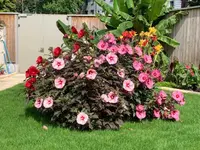
Sturdy stake setup

Install 2–3 unobtrusive stakes or a low peony-style ring around the clump in late spring before stems get tall, then loosely tie stems with soft ties to prevent wind damage and stem snapping once the large blooms develop.

Targeted bud deadheading

During peak bloom, regularly remove spent flowers and any seed pods forming behind them so the plant redirects resources into producing more buds instead of seed.

Mulch for root cooling

Apply a 5–8 cm layer of bark mulch around, but not touching, the crown to keep the shallow roots cool, stabilize soil moisture, and reduce heat stress in midsummer.

Dormant season marking

After the first hard frost, cut stems back to 5–10 cm and place a visible marker at the crown location so the plant is not disturbed during winter cleanup or early spring digging, which supports long-term success when caring for Hibiscus 'Kopper King'.

Common Pests and Diseases

Japanese beetles

These insects skeletonize the large leaves and chew ragged holes in flower buds, often appearing in large groups on sun-warmed foliage and blooms.

Solution

Hand-pick beetles in the early morning into soapy water, use fine mesh or row covers during peak beetle season, and avoid nearby lawn grubs by managing turf to reduce the beetle lifecycle. Neem oil or spinosad products can be used on foliage and buds according to label directions when pressure is high.

Hibiscus sawfly larvae

These pests feed along leaf edges and between veins, leaving lace-like damage that can quickly defoliate young or stressed plants.

Solution

Inspect leaves regularly from late spring and crush or remove larvae by hand, focusing on undersides and tender growth. For heavier infestations, apply a targeted insecticide labeled for sawflies, such as spinosad or insecticidal soap, making sure to cover leaf undersides and repeat as directed.

Aphids

These insects cluster on tender stems, buds, and leaf undersides, causing curling, distortion, sticky honeydew, and sometimes black sooty mold growth.

Solution

Spray plants with a strong stream of water to dislodge colonies, then use insecticidal soap or horticultural oil on new growth and bud clusters. Encourage or protect natural predators such as lady beetles and lacewings, and avoid high-nitrogen fertilization that promotes overly soft growth.

Japanese hibiscus leaf spot

This disease causes small tan to dark-brown circular spots on leaves that may merge into larger blotches, leading to premature yellowing and leaf drop in warm, humid weather.

Solution

Remove and discard affected leaves and fallen debris to reduce fungal spores, and water at soil level rather than over the foliage. Improve spacing and airflow, and in recurrent cases use a preventive fungicide labeled for hibiscus leaf spot at the start of warm, wet periods.

Fusarium wilt

Symptoms include sudden wilting, yellowing, and dieback of stems, often starting on one side of the plant, while roots and soil remain moist.

Solution

Remove and destroy affected stems and severely infected plants, and avoid replanting hibiscus in the same spot if dieback was extensive. Improve drainage, avoid overwatering and mechanical injury to roots, and choose disease-free nursery stock when growing Hibiscus 'Kopper King' in beds with a history of wilt problems.

Interesting Facts

Copper foliage genetics

This cultivar was selected from hybrid hibiscus breeding for its distinctive bronze to copper-red foliage, which comes from complex crosses involving North American hardy hibiscus species such as Hibiscus moscheutos and Hibiscus coccineus.

Dinner-plate flower size

Mature plants commonly produce individual blooms up to about 20–25 cm across, placing it among the largest-flowered hardy perennials suitable for temperate gardens and making it visually comparable to some tropical hibiscus in impact.

Cold-hardy perennial roots

Although the top growth dies back after frost, its root system can reliably overwinter in many temperate regions down to about USDA zone 4–5 when soil drainage and mulching are adequate, allowing gardeners to grow Hibiscus 'Kopper King' in climates far too cold for tropical hibiscus.

Botan icon

Did you know?

The original plant was introduced in the late 1990s by American breeders known for hardy hibiscus work, and its combination of copper foliage with large, pale flowers marked a notable shift in ornamental hibiscus breeding toward foliage color as a design feature, not just flower display.

FAQs about Hibiscus 'Kopper King'

This is a hardy perennial that dies back to the ground each winter and re-sprouts from the crown in spring. In suitable climates it returns every year if the root system is not waterlogged or frozen solid.

Grow Healthy Plants with Botan Care

Keep your plants happy and healthy with plant identification, disease detection, and easy care guidance.

Botan plant care app — identify plants on mobile

Explore More Plants