

Use moss-friendly substrate
Attach the moss to soaked, well-aged hardwood, lava rock, or rough bark rather than compact soil, as a vertical or sloped surface allows better drainage and prevents the delicate shoots from rotting at the base.

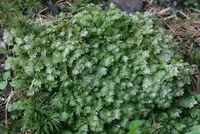
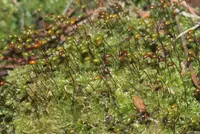
Hookeria lucens, commonly called hookeria moss, is a bright green, creeping moss that forms soft, glossy carpets on damp surfaces. It is a non-vascular plant, meaning it absorbs water and nutrients directly through its leaves.
In nature, it is most often found in shaded, humid forests, growing on rocks, rotting logs, and wet soil near streams or waterfalls. Its flat, overlapping leaves create a lush, fern-like look that many terrarium and vivarium keepers value.
This moss prefers cool, shaded conditions, constant moisture, and clean, slightly acidic substrates. These needs make it moderately challenging to keep in dry homes, so learning how to care for hookeria moss is important for long-term success.

Care Difficulty
Hard Care

Light Preference
Shade

Water Requirements
Keep Soil Moist

Temperature Preference
Cool Climate

Hardiness Zone
6–9

Soil Texture
Loamy, Silty, Organic-rich

Soil pH
Strongly acidic (4.5–5.5), Acidic (5.5–6.5)

Soil Drainage
Waterlogged tolerant

Fertilization
Minimal (feed rarely)
Scan your plant to receive care tips personalized for your specific plant
Available on iOS and Android
This moss prefers cool, shaded woodland-type light with no direct harsh sun.
Watering should keep the substrate constantly moist but never stagnant around the rhizoids.
This species thrives in cool, consistently mild conditions with high ambient humidity.
This moss needs very high, consistent humidity to stay lush and photosynthetically active.
Hookeria lucens prefers a constantly moist, soft, and highly organic substrate that mimics wet stream banks or seeps.
This species can grow in shallow containers or terrariums if moisture and stability are tightly controlled.
This moss relies mostly on clean, nutrient-poor moisture and usually needs no added fertilizer for healthy growth.
Hookeria lucens needs only light tidying to maintain an even, healthy carpet of moss.
Transplanting Hookeria lucens is occasional and should be done with minimal disturbance to its shallow, delicate rhizoids.
Propagation of Hookeria lucens is usually done by dividing existing mats rather than from spores in home settings.
This moss is generally cold hardy in temperate climates and needs limited winter care when grown outdoors.

Plant Health Check
Not sure what's wrong with your plant? Check your plant's health inside the app.
This moss has unusually broad, thin, and shiny leaves that lie in a single plane, forming a flattened frond-like shoot. The glossy surface helps water run off quickly while still keeping the plant evenly moist in its streamside habitat.
Hookeria lucens typically grows on rocks and banks in humid, shaded ravines where the water and substrate are slightly alkaline or base-rich, often linked to calcareous or neutral geology. Its distribution closely follows these chemically suitable, cool, oceanic microclimates in western Europe and similar regions.
Populations of this species are often used by bryologists as indicators of long-term, consistently high humidity in woodlands and ravines. Where it thrives, the local microclimate is usually cool, shaded, and buffered from short-term drying events.

In parts of its range, especially in western Europe, Hookeria lucens is considered a conservation-significant moss whose presence can help identify ancient or long-continuity woodland, because it colonizes and persists only where undisturbed, humid forest conditions have been maintained over long periods.
This species grows best outdoors in cool, humid, shaded sites such as stream banks, rock faces, and woodland gardens. Indoors it is difficult to maintain stable moisture and airflow, so long‑term success is uncommon.
Keep your plants happy and healthy with plant identification, disease detection, and easy care guidance.

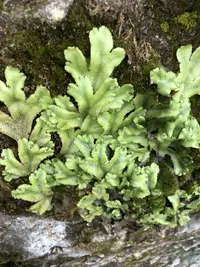
Snakewort
Conocephalum salebrosum
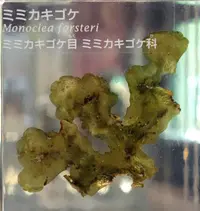
Monoclea forsteri
Monoclea forsteri
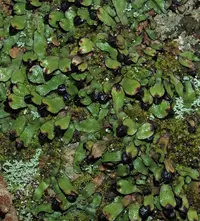
Orobus-seed Liverwort
Targionia hypophylla
Lateral Cryphaea
Cryphaea heteromalla
Heller's Notchwort
Crossocalyx hellerianus
Swartz's Feather-moss
Oxyrrhynchium hians
brachythecium moss
Brachythecium albicans
velvet feather-moss
Brachytheciastrum velutinum