

Moisture monitoring
Use a simple soil moisture probe or your finger to check that the upper 1–2 cm of the forest substrate stays evenly moist but not waterlogged, since this fungus relies on stable surface moisture for reliable fruiting.

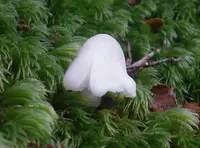
Humidicutis mavis is a small, waxy-capped mushroom known for its delicate pale lilac to whitish fruiting bodies and slender stems. It is a fungus, not a leafy houseplant, and appears seasonally rather than year-round.
This species is typically found in moist, mossy forest floors, often in temperate regions with high humidity and decaying organic matter. It relies on specific woodland microhabitats, which makes it challenging to cultivate artificially.
Most people observe it in nature rather than attempt to care for Humidicutis mavis at home. It generally favors cool, shaded conditions with consistently damp, well-drained, humus-rich substrates.

Care Difficulty
Hard Care

Light Preference
Partial Shade

Water Requirements
Keep Soil Moist

Temperature Preference
Cool Climate

Hardiness Zone
Unknown

Soil Texture
Loamy, Peaty, Organic-rich

Soil pH
Strongly acidic (4.5–5.5), Acidic (5.5–6.5)

Soil Drainage
Moist but well-drained

Fertilization
Minimal (feed rarely)
Scan your plant to receive care tips personalized for your specific plant
Available on iOS and Android
This woodland fungus prefers low to moderate light that mimics a shaded forest floor.
Moist, humus-rich soil is essential for reliable fruiting of this woodland mushroom.
This species fruits best in mild, consistently cool to moderate temperatures.
This fungus prefers consistently moist, high-humidity conditions around its fruiting site.
This mycorrhizal fungus relies on suitable, consistently moist forest-type soil rather than a conventional potting mix.
This species is generally unsuitable for long-term container growing, as it depends on complex soil and host-root interactions.
This wild, mycorrhizal fungus is not a typical houseplant and does not need direct fertilization in natural or garden settings.
Humidicutis mavis does not require conventional pruning, since each mushroom is a short-lived fruiting body rather than a permanent stem or shrub structure.
In cultivation, focus on establishing and maintaining the fungal mycelium in a stable, undisturbed site rather than repotting individual fruiting bodies.
Propagation of this fungus is specialized and usually left to habitat management or expert culture, not routine home methods.
This woodland fungus is generally cold tolerant in climates where it naturally occurs and needs no active winter care in the ground.

Plant Health Check
Not sure what's wrong with your plant? Check your plant's health inside the app.
This species is known for its distinctive pale lilac to whitish caps that can show subtle greenish or bluish tints, a color combination that sets it apart from the more vividly colored waxcaps. The pigments are water-soluble, so rainfall often softens and washes out the colors over time.
Humidicutis mavis is typically associated with damp, mossy forest floors, especially in southern Australia and New Zealand. It often appears among leaf litter and moss in intact, undisturbed habitats, which makes it a useful indicator of relatively healthy forest microclimates.
The fruiting bodies have a waxy, somewhat translucent flesh and smooth, moist caps, placing it among the waxcap-like fungi in the Hygrophoraceae family. The gills are thick, widely spaced, and often decurrent, meaning they run slightly down the stem, which helps distinguish it from many other small forest mushrooms.

Molecular studies have clarified that this species, once placed in the genus Hygrocybe, is distinct enough to warrant inclusion in Humidicutis, reflecting how DNA evidence has reshaped understanding of waxcap relationships and led to several reclassifications in this group.
This mushroom is not considered a common edible species and should not be eaten. Identification within waxcap fungi is difficult, and misidentification can be dangerous. Treat it as a non-edible, ornamental species only.
Keep your plants happy and healthy with plant identification, disease detection, and easy care guidance.

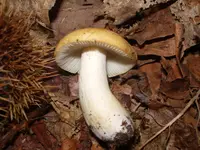
Ochre Brittlegill
Russula ochroleuca
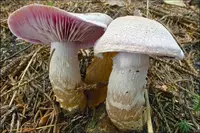
goatcheese webcap
Cortinarius camphoratus
Neolentinus cyathiformis
Neolentinus cyathiformis
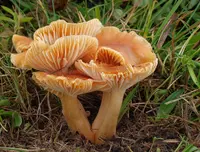
Meadow Waxcap
Cuphophyllus pratensis
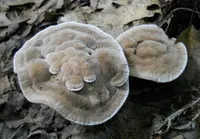
Velvet tooth
Hydnellum spongiosipes
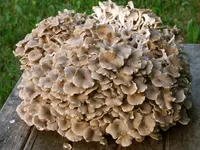
umbrella polypore
Polyporus umbellatus
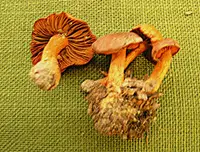
cinnabar webcap
Cortinarius cinnabarinus
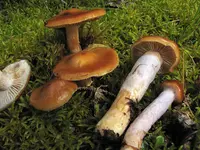
blue-girdled webcap
Cortinarius collinitus