Host tree selection
Choose or inoculate compatible conifer hosts such as spruce, pine, or hemlock in low-fertilizer, low-disturbance ground, since the fungus depends on a stable mycorrhizal partnership with suitable trees to persist.

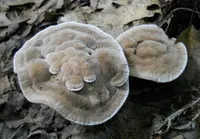
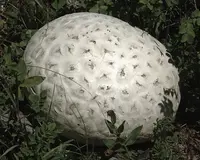
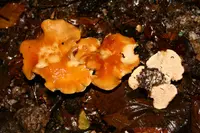
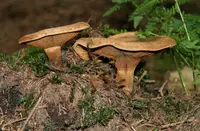
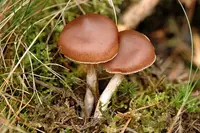
Velvet tooth (Hydnellum spongiosipes) is a tooth fungus, not a leafy plant, forming thick, irregular caps with a spongy surface and soft spines underneath. It often shows muted brown tones that blend into the forest floor.
This species grows naturally in temperate forests, usually among moss and leaf litter, often in association with conifer or broadleaf trees. It forms mycorrhiza, a mutual partnership with tree roots, which makes it difficult to cultivate at home.
Gardeners interested in how to care for Velvet tooth should understand that it relies on healthy woodland soil, steady moisture, and shade, and is best appreciated in its natural habitat rather than as a traditional garden specimen.

Care Difficulty
Hard Care

Light Preference
Partial Shade

Water Requirements
Regular Water

Temperature Preference
Cool Climate

Hardiness Zone
4–7

Soil Texture
Loamy, Peaty, Organic-rich

Soil pH
Strongly acidic (4.5–5.5), Acidic (5.5–6.5)

Soil Drainage
Moist but well-drained

Fertilization
Minimal (feed rarely)
Scan your plant to receive care tips personalized for your specific plant
Available on iOS and Android
This ectomycorrhizal fungus prefers cool, forested light conditions rather than open sun.
This woodland fungus depends on consistently moist, not waterlogged, soil around its host trees.
This species fruits best in cool to mild woodland temperatures.
This ectomycorrhizal fungus does not adapt well to controlled indoor humidity and is best left in natural forest conditions.
This species relies on a living association with tree roots in cool, moist forest soil rather than a conventional potting substrate.
This fungus is not suitable for container growing, as it depends on complex interactions with living tree roots and forest soil microbiology.
Hydnellum spongiosipes is a mycorrhizal woodland fungus that does not need fertilization in garden or container culture.
Pruning is not a standard practice for Hydnellum spongiosipes, since the fruiting body is seasonal and short-lived.
Transplanting is rarely successful because this fungus depends on a stable mycorrhizal partnership with tree roots.
Intentional propagation of Hydnellum spongiosipes is technically complex and not practical for home growers.
This fungus is naturally cold hardy in its native range and needs no special winter care in outdoor woodland conditions.

Plant Health Check
Not sure what's wrong with your plant? Check your plant's health inside the app.
The fruiting body develops a dense layer of downward-pointing spines instead of gills or pores, and its cap tissue has a noticeably spongy, cushion-like consistency when fresh, which inspired the species name spongiosipes (spongy foot).
This fungus is typically found in very acidic, nutrient-poor conifer forests, especially under spruce and pine, indicating its preference for low-pH, organic-rich soils where many other fungi struggle to fruit.
It forms ectomycorrhizal associations with conifer roots, creating a sheath around fine roots and extending hyphae into the soil, which can improve tree access to water and minerals in exchange for sugars from photosynthesis.

This species is considered rare or of conservation interest in several European countries, and long-term monitoring projects use its presence as an indicator of relatively undisturbed, old coniferous forest habitats.
This fungus is best kept outdoors, as it relies on a symbiotic relationship with tree roots and natural forest soil. Indoors it rarely survives, so Velvet tooth indoor care is generally not recommended.
Keep your plants happy and healthy with plant identification, disease detection, and easy care guidance.