Use hardwood blocks
Inoculate freshly cut, untreated hardwood logs or blocks (oak, beech, maple) within 4–6 weeks of felling to give the fungus a clean, low-competition substrate for reliable fruiting.

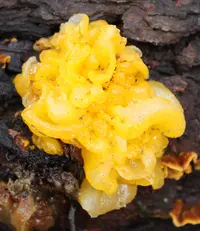
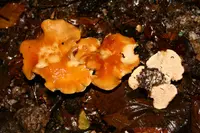
Golden ear, Tremella aurantia, is a jelly fungus rather than a true plant. It forms bright yellow to orange, lobed, brain-like clusters on decaying wood, especially hardwood branches. The texture is soft and gelatinous, and the fruiting bodies often appear after rain.
This species occurs mainly in temperate forests, including parts of North America, Europe, and Asia, where it grows as a parasite on other fungi that decompose wood. Its need for specific fungal hosts and moist, shaded conditions makes it difficult to cultivate at home, so most people do not actively care for golden ear. In nature, it prefers consistently damp environments and rotting wood rather than regular garden soil.

Care Difficulty
Hard Care

Light Preference
Shade

Water Requirements
Keep Soil Moist

Temperature Preference
Cool Climate

Hardiness Zone
Unknown

Soil Texture
Loamy, Organic-rich

Soil pH
Acidic (5.5–6.5)

Soil Drainage
Waterlogged tolerant

Fertilization
Minimal (feed rarely)
Scan your plant to receive care tips personalized for your specific plant
Available on iOS and Android
This jelly fungus favors dappled woodland-style light rather than direct, open sun.
Moist, never stagnant conditions are essential for reliable fruiting of this wood-inhabiting fungus.
This species prefers cool to mild conditions and is sensitive to both hard frost and extreme heat.
This wood-decaying jelly fungus needs consistently very high humidity to form healthy fruiting bodies.
Tremella aurantia grows on decaying wood, so it is managed on substrate rather than conventional soil.
This species can be grown in containers only when they function as moisture-retentive, aerated substrates rather than decorative pots.
Tremella aurantia is a wood-decaying fungus that usually gains nutrients from its host and needs little to no additional fertilizer in garden conditions.
Pruning is not a standard practice for Tremella aurantia, since the fruiting bodies are temporary fungal structures, not woody growth.
This species is not conventionally repotted, as Tremella aurantia develops on dead or dying wood rather than in typical potting substrates.
Propagation of Tremella aurantia is specialized and usually managed by fungal growers using inoculation techniques rather than casual home methods.
In most temperate climates, Tremella aurantia requires minimal winter care because the main organism lives protected within wood as mycelium.

Plant Health Check
Not sure what's wrong with your plant? Check your plant's health inside the app.
This fungus forms its bright orange, gelatinous fruitbodies only when parasitizing the crust fungus Stereum hirsutum, rather than decaying wood directly on its own.
Although often confused with the related Tremella mesenterica (yellow brain fungus), it can be distinguished by its more orange coloration and its strict association with Stereum species on hardwood branches.
Under the microscope, its basidia (spore-bearing cells) are characteristically divided by vertical septa and produce smooth, globose to ellipsoid basidiospores that enable long-distance dispersal by wind.

Tremella aurantia is a classic example of a mycoparasite, meaning it lives by attacking and deriving nutrients from another fungus rather than directly from plant or animal material, illustrating a highly specialized ecological niche within forest decomposer communities.
This fungus is considered edible when properly identified and collected from clean environments, but it has little flavor and is mainly valued for texture. Never eat wild specimens unless confirmed by a local mycologist or expert guide.
Keep your plants happy and healthy with plant identification, disease detection, and easy care guidance.