Retain Forest Litter
Leave a layer of native leaf litter and small twigs over the soil where the fungus grows, since this mimics its natural forest floor habitat and helps maintain the cool, stable microclimate it needs.

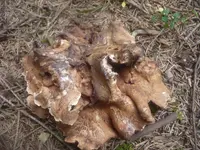
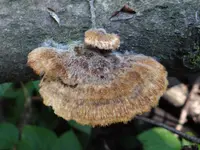
Hydnellum versipelle is a tooth fungus, not a typical garden plant. It forms irregular, often cushion-like caps with tiny downward spines instead of gills. Colors range from pale to darker browns, sometimes with mottled or zoned patterns. The texture is usually tough and corky rather than fleshy.
This species grows naturally on the ground in coniferous and mixed forests, mainly in temperate regions of Europe and parts of North America. It lives in symbiosis with tree roots, which makes it very hard to cultivate. Due to this mycorrhizal lifestyle, it is not suited to regular pot culture, and how to care for Hydnellum versipelle in a home setting is largely experimental.

Care Difficulty
Hard Care

Light Preference
Shade

Water Requirements
Regular Water

Temperature Preference
Cool Climate

Hardiness Zone
Unknown

Soil Texture
Loamy, Sandy, Organic-rich

Soil pH
Strongly acidic (4.5–5.5), Acidic (5.5–6.5)

Soil Drainage
Moist but well-drained

Fertilization
Minimal (feed rarely)
Scan your plant to receive care tips personalized for your specific plant
Available on iOS and Android
This woodland fungus prefers cool, shaded forest conditions with minimal direct sun exposure.
This ectomycorrhizal fungus depends on consistently moist, not soggy, forest soil.
This species thrives in cool to mild woodland climates with moderate seasonal variation.
Humidity is not a major factor for Hydnellum versipelle compared with shade, host trees, and soil conditions.
Hydnellum versipelle is a mycorrhizal fungus that requires specific forest-floor conditions rather than a standard garden bed or potting mix.
This species is not realistically suitable for container growing because it depends on complex mycorrhizal associations with living trees in natural soil.
This woodland fungus forms mycorrhizal partnerships with trees and does not benefit from direct fertilization in gardens or containers.
Pruning is not applicable to this fungus, as the visible fruiting bodies are temporary structures and do not require shaping or maintenance.
This species is not suited to conventional repotting or transplanting because it depends on a stable mycorrhizal relationship with host tree roots.
Propagation of this mycorrhizal fungus is technically complex and is not practical for typical home gardeners.
This fungus is naturally cold hardy in its native range and needs no special winter care when growing in suitable woodland conditions.

Plant Health Check
Not sure what's wrong with your plant? Check your plant's health inside the app.
This species forms a tooth fungus, producing spore-bearing teeth or spines on the underside of the cap instead of gills or pores, which places it in the family Bankeraceae.
The cap surface shows notable color variation during development, often appearing in mottled shades of gray, brown, and bluish tones that can shift as the fruiting body ages and dries.
Hydnellum versipelle forms ectomycorrhizal associations with coniferous trees, exchanging mineral nutrients and water from the soil for sugars from the host tree, and thus plays a role in nutrient cycling in boreal and temperate forests.

This species, like several closely related Hydnellum fungi, is considered a conservation concern in parts of Europe, where its populations have declined due to habitat loss and changes in forest management, and it is included on regional red lists of threatened fungi.
This tooth fungus is adapted to outdoor forest conditions, forming a mycorrhizal partnership with trees. It does not adapt to typical indoor environments, so Hydnellum versipelle indoor care is not practical or recommended.
Keep your plants happy and healthy with plant identification, disease detection, and easy care guidance.