Host Wood Selection
Use well-seasoned, bark-free hardwood logs or blocks from oak, beech, or maple, since consistent, dense wood provides a more stable substrate for Hydnoporia olivacea colonization than soft, fast-rotting species.

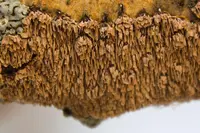
Brown-toothed crust fungus, Hydnoporia olivacea, is a wood-decaying fungus, not a leafy plant. It forms thin, spreading crusts on dead or dying wood. The surface is usually brown to olive-brown with tiny tooth-like projections that give it a rough texture. It grows flat against bark or exposed wood rather than forming caps or stems. This species occurs mainly in temperate forests, especially on fallen branches and logs. It plays an important role in breaking down wood and returning nutrients to the soil. In cultivation, it can be challenging because it needs consistently moist wood, shade, and stable conditions, so anyone wanting to learn how to care for brown-toothed crust fungus should be prepared for a specialized setup.

Care Difficulty
Moderate Care

Light Preference
Partial Shade

Water Requirements
Moderate Water

Temperature Preference
Cool Climate

Hardiness Zone
Unknown

Soil Texture
Loamy, Organic-rich

Soil pH
Slightly acidic (6.5–7.0)

Soil Drainage
Moist but well-drained

Fertilization
Minimal (feed rarely)
Scan your plant to receive care tips personalized for your specific plant
Available on iOS and Android
Hydnoporia olivacea prefers low to moderate, indirect forest light rather than direct sun exposure.
This wood-decaying species relies on consistently moist, never waterlogged, conditions around its host substrate.
This fungus is adapted to cool to mild woodland climates and shows best development in temperate conditions.
This wood-decaying fungus prefers consistently moist, high-humidity environments around 70–90%.
Hydnoporia olivacea grows on dead wood rather than in true soil, but the surrounding substrate still influences moisture and aeration.
This species is suitable for container cultivation only when dead wood is used as the main substrate.
Hydnoporia olivacea is a wood-decaying fungus that normally grows on nutrient-rich hosts and does not benefit from deliberate fertilization in cultivation.
Pruning is not a standard practice for Hydnoporia olivacea, since it forms resupinate crusts rather than stems or foliage.
Transplanting this crust-forming fungus focuses on moving colonized wood rather than disturbing a root system.
Propagation of Hydnoporia olivacea is specialized and usually left to expert mycologists managing research or conservation work.
Hydnoporia olivacea is naturally cold hardy and generally needs no special winter care in outdoor conditions.

Plant Health Check
Not sure what's wrong with your plant? Check your plant's health inside the app.
This crust fungus forms a tightly attached, brown to olive-brown layer on dead hardwood with a distinctly toothed or spiny fertile surface, rather than a smooth or pore-bearing one.
It lives as a saprotroph on dead broadleaf wood, where its enzymes break down structural components of the wood and contribute to nutrient recycling in temperate forests.
Field surveys in Europe and parts of North America show it is strongly associated with well-decayed hardwoods, especially beech and other broadleaf logs, and is rarely reported from conifers.
This wood-decaying species is best maintained outdoors on dead hardwood in shaded, moist conditions. Indoors it usually fails long term because air is too dry, airflow is low, and suitable fresh wood is limited.
Keep your plants happy and healthy with plant identification, disease detection, and easy care guidance.