

Use Sterile Substrate
Prepare hardwood sawdust or finely chipped hardwood and sterilize it in a pressure cooker before inoculation to reduce contamination from competing fungi and bacteria when growing Spring Polypore.

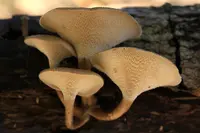
Spring polypore, Polyporus arcularius, is a small wood-decay fungus rather than a leafy plant. It forms thin, tan to yellow-brown caps with tiny pores underneath and a slender central stem. Caps often have a slightly scaly surface and appear in groups on fallen hardwood branches or logs. It is most common in spring, especially in temperate forests across North America, Europe, and parts of Asia.
This species feeds on dead wood, helping break down tough plant material and recycle nutrients. It is not a typical choice for home cultivation, as it needs consistently moist, woody substrates and stable conditions. For those interested in how to care for Spring Polypore, focus on providing clean hardwood material, good air flow, and moderate, steady humidity.

Care Difficulty
Moderate Care

Light Preference
Partial Shade

Water Requirements
Keep Soil Moist

Temperature Preference
Cool Climate

Hardiness Zone
Unknown

Soil Texture
Loamy, Organic-rich

Soil pH
Acidic (5.5–6.5), Slightly acidic (6.5–7.0)

Soil Drainage
Moist but well-drained

Fertilization
Minimal (feed rarely)
Scan your plant to receive care tips personalized for your specific plant
Available on iOS and Android
This bracket fungus prefers dappled woodland light rather than direct, exposed sun.
This wood-decaying fungus depends more on consistent substrate moisture than on direct watering.
This species fruits best in cool to mild conditions typical of spring woodland climates.
Humidity is not a major factor for Polyporus arcularius growing on natural wood substrates outdoors.
This wood-decaying fungus does not use soil in the same way as vascular plants and relies instead on dead hardwood as its substrate.
This species is generally unsuitable for conventional container growing because it requires colonizable wood rather than soil.
This wood-decaying fungus typically gains all needed nutrients from its substrate and does not require additional fertilizer in natural or cultivated settings.
Polyporus arcularius does not need true pruning; management focuses on removing unwanted fruiting bodies rather than shaping growth.
This fungus is not grown in traditional pots, so management focuses on moving or renewing colonized wood rather than repotting.
Propagation of Polyporus arcularius is specialized and usually handled by experienced growers rather than casual plant keepers.
This temperate wood-rotting fungus is naturally cold hardy and usually needs no special winter care outdoors.

Plant Health Check
Not sure what's wrong with your plant? Check your plant's health inside the app.
This species is one of the earliest small bracket fungi to appear, typically fruiting in spring on fallen hardwood branches when many other polypores are still absent. Its consistent early-season timing is the reason for the common name spring polypore.
The cap surface shows a dense pattern of small, brown, appressed scales on a paler background, creating a finely textured appearance that helps distinguish it from other small, stalked polypores. These scales often become more pronounced toward the cap center as the fruiting body matures.
The underside has very small, angular pores arranged in a honeycomb-like pattern that stay relatively firm rather than crumbly, even in older specimens. This combination of tiny pores and a thin yet tough pore layer is characteristic for reliable field identification.

Microscopic features of this species include ornamented, spiny spores and distinctive hair-like structures on the cap surface, which mycologists use as key characters when confirming identifications under the microscope.
This species is generally considered inedible due to its small size and tough, leathery texture. It is not used as a culinary mushroom, though it may have ecological interest for those studying wood-decay fungi in forests.
Keep your plants happy and healthy with plant identification, disease detection, and easy care guidance.

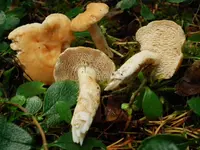
depressed hedgehog
Hydnum umbilicatum
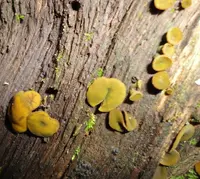
olive-brown cup
Chlorencoelia versiformis
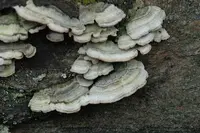
Purplepore Bracket
Trichaptum abietinum
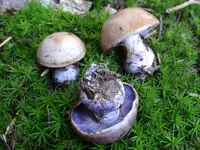
blushing webcap
Cortinarius cyanites
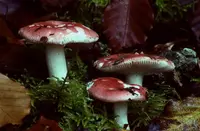
Beechwood Sickener
Russula nobilis
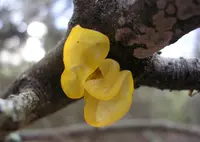
witch's butter
Tremella mesenterica
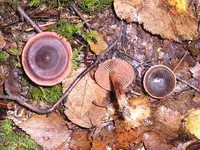
Cortinarius anthracinus
Cortinarius anthracinus
Wrinkled Cortinaria
Cortinarius caperatus