Choose host wood
Select seasoned but not fully decayed willow logs or large branches with intact bark, as this fungus colonizes more reliably on moderately fresh Salix wood than on highly decomposed pieces.

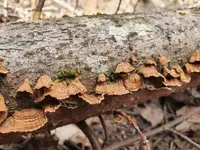
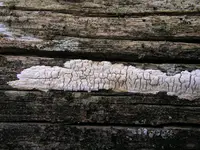
Hydnoporia tabacina, sometimes called willow glue, is a wood-decaying fungus rather than a typical leafy plant. It usually forms flat, spreading, crust-like patches on dead or weakened wood, especially on willow and other broadleaf trees. The surface can look smooth to slightly lumpy, with colors ranging from pale to deeper brown as it ages.
This fungus occurs mainly in temperate regions, often in damp woodlands and along waterways where host trees grow. It is not commonly cultivated, so information on how to care for willow glue in a home or garden setting is limited. Its reliance on specific deadwood substrates makes it challenging to grow deliberately.

Care Difficulty
Hard Care

Light Preference
Shade

Water Requirements
Keep Soil Moist

Temperature Preference
Cool Climate

Hardiness Zone
Unknown

Soil Texture
Organic-rich, Peaty

Soil pH
Acidic (5.5–6.5)

Soil Drainage
Moist but well-drained

Fertilization
Minimal (feed rarely)
Scan your plant to receive care tips personalized for your specific plant
Available on iOS and Android
This fungus prefers stable, indirect forest light rather than strong, open sun.
Hydnoporia tabacina depends on consistently moist but not waterlogged wood or bark.
This species favors cool to mild conditions with limited temperature extremes.
This wood-decaying fungus tolerates a wide humidity range but grows best in consistently moist, humid conditions.
Hydnoporia tabacina naturally colonizes dead wood rather than soil, so the key is preparing a suitable woody substrate environment.
This species is not naturally suited to conventional container growing and is better established on outdoor logs or wooden structures, so container culture is rarely practical.
Hydnoporia tabacina growing on living or dead willow typically needs no added fertilizer, as it derives nutrients from the host wood.
Pruning Hydnoporia tabacina is rarely required and is mainly done for safety or aesthetic reasons on the host tree.
In cultivation, willow glue is usually left on its original host wood rather than transplanted or repotted.
Propagation of Hydnoporia tabacina is specialized and usually left to mycologists or advanced hobbyists.
Hydnoporia tabacina on hardy willow or similar hosts in temperate climates generally needs no special winter care.

Plant Health Check
Not sure what's wrong with your plant? Check your plant's health inside the app.
When fresh, its fruiting bodies often release a strong, dry tobacco-like smell, which inspired the species epithet tabacina and is used as a field clue for identification.
This fungus is a specialized parasite and saprobe of living and dead willow wood, particularly Salix fragilis and related species, causing a characteristic white rot as it digests lignin in the wood.
Instead of forming classic mushroom caps, it grows as a flat, crust-like layer tightly attached to the underside of logs and branches, with a pitted, hydnoid (tooth-bearing) fertile surface.

Molecular studies have shown that this species, historically placed in several different genera, belongs in the genus Hydnoporia within the Hymenochaetales, helping clarify the evolutionary relationships of several poorly understood crust fungi associated with woody hosts.
This fungus spreads along dead or decaying hardwood, especially willow, via spores and mycelial growth. It can cover large areas of bark but does not jump to healthy plants or spread through soil like invasive weeds.
Keep your plants happy and healthy with plant identification, disease detection, and easy care guidance.