Host tree selection
Establish this ectomycorrhizal fungus in mixed woodland or near compatible host trees such as oaks or pines, since productive fruiting depends on forming root associations rather than on a simple woodchip or compost bed.

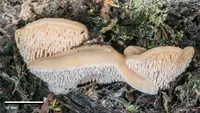
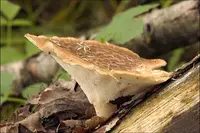
Hydnum crocidens is a fungus, not a leafy houseplant, known for its toothed spore-bearing surface instead of gills. It forms fleshy, irregular caps with soft spines underneath.
This species typically grows on soil in forested areas, often in association with trees, forming mycorrhizal partnerships that help roots absorb nutrients. It is usually found in temperate regions and appears seasonally, rather than as a year-round ornamental feature.
For those interested in how to care for Hydnum crocidens in cultivation, conditions that mimic a cool, moist woodland floor with decaying organic matter are most relevant, though it is rarely grown indoors or in standard garden beds.

Care Difficulty
Moderate Care

Light Preference
Partial Shade

Water Requirements
Moderate Water

Temperature Preference
Warm Climate

Hardiness Zone
Unknown

Soil Texture
Loamy

Soil pH
Slightly acidic (6.5–7.0)

Soil Drainage
Well-drained

Fertilization
Minimal (feed rarely)
Scan your plant to receive care tips personalized for your specific plant
Available on iOS and Android
This ectomycorrhizal fungus prefers bright, forest-filtered light rather than open, direct sun.
Moist, well-drained, organically rich soil is essential for this woodland fungus and its tree partners.
This species fruits best in cool to mild conditions typical of temperate forests.
This fungus is not suited to typical home humidity control and relies on naturally moist forest conditions.
In nature, Hydnum crocidens fruits on decaying wood and forest litter rather than in standard horticultural soil.
This species is generally unsuitable for typical ornamental container cultivation at home.
This ectomycorrhizal fungus obtains nutrients mainly through its tree partners and usually does not need additional fertilizer in natural or woodland-style plantings.
As a wild ectomycorrhizal fungus, Hydnum crocidens does not require structured pruning; fruiting bodies are temporary and decompose naturally.
Cultivation in containers is uncommon; focus instead on careful transplanting of associated host trees and maintaining suitable forest-like soil conditions.
True propagation relies on spore dispersal and establishing fresh mycorrhizal relationships, which is technically challenging outside research or specialized cultivation.
This fungus is naturally cold hardy in its native range and usually needs no special winter care when left in a stable woodland setting.

Plant Health Check
Not sure what's wrong with your plant? Check your plant's health inside the app.
Instead of gills or pores, this species produces spines or teeth on the underside of the cap, a characteristic feature of the genus Hydnum that increases surface area for spore production.
Hydnum crocidens forms ectomycorrhizal associations with trees, exchanging mineral nutrients and water from the soil for photosynthates from the host, and thus plays a role in forest nutrient cycling.
Microscopic studies show that its spores have species-specific size and ornamentation patterns, which help mycologists separate H. crocidens from closely related tooth fungi during identification.
This is a tooth fungus, and related Hydnum species are often considered edible, but identification can be tricky. Only consume specimens confirmed by an experienced mycologist, as misidentification with similar, unsafe fungi is possible.
Keep your plants happy and healthy with plant identification, disease detection, and easy care guidance.