Host grass management
Maintain a short, lightly managed sward of fine grasses by mowing high and removing clippings so that competing coarse grasses do not shade out the mycelium that supports the fruiting bodies.

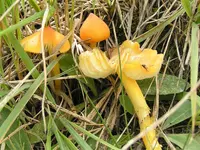
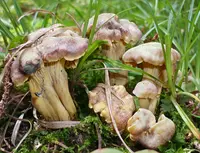
Persistent waxcap, Hygrocybe acutoconica, is a small, grassland mushroom rather than a typical foliage plant. It forms slim, delicate fruiting bodies with conical to bell-shaped caps, often in bright yellow to orange tones. Stems are thin and somewhat fragile, giving the group a light, scattered look in short turf.
This species is usually found in unimproved grasslands, lawns, and meadows, especially where soils are low in nutrients and not heavily disturbed. It can be challenging to grow intentionally, because it depends on complex soil relationships and stable grassland conditions. Gardeners who want to care for Persistent Waxcap need to focus on maintaining low-fertilizer, undisturbed, consistently moist but well-drained turf.

Care Difficulty
Hard Care

Light Preference
Partial Shade

Water Requirements
Keep Soil Moist

Temperature Preference
Cool Climate

Hardiness Zone
Unknown

Soil Texture
Loamy, Sandy, Organic-rich

Soil pH
Strongly acidic (4.5–5.5), Acidic (5.5–6.5)

Soil Drainage
Moist but well-drained

Fertilization
Minimal (feed rarely)
Scan your plant to receive care tips personalized for your specific plant
Available on iOS and Android
This woodland fungus prefers soft, indirect light rather than strong, direct sun.
This grassland mushroom needs consistently moist, but not waterlogged, soil to form fruiting bodies.
This species fruits best in cool to mild conditions typical of temperate grasslands.
This fungus needs consistently moist, humid conditions around the fruiting area rather than controlled indoor air humidity.
This grassland fungus fruits best in undisturbed, low-nutrient, moist but free-draining soil.
This species is not well suited to container growing, as it relies on complex soil and grassland conditions that are hard to reproduce in pots.
Hygrocybe acutoconica is a wild grassland fungus that generally should not be fertilized, as added nutrients disrupt its natural soil community.
Pruning is not part of normal care for Hygrocybe acutoconica, since it is a small, short-lived mushroom rather than a perennial plant.
Transplanting this grassland fungus is rarely successful, as it depends on specific low-nutrient soil conditions and microbial partners.
Propagation of Hygrocybe acutoconica is difficult and rarely attempted outside scientific or conservation settings.
This species is adapted to natural outdoor conditions and typically needs no special winter care in its hardiness range.

Plant Health Check
Not sure what's wrong with your plant? Check your plant's health inside the app.
This waxcap has a sharply conical, often acutely pointed cap when young, which helps distinguish it from many other Hygrocybe species with more rounded or bell-shaped caps.
The fruiting bodies typically emerge bright yellow to orange-yellow and then fade to paler yellow or almost straw-colored as they mature and dry, making older specimens much less vivid than young ones.
It was long confused with other yellow waxcaps until detailed microscopic and chemical studies showed it is likely inedible or mildly toxic, so it is not recommended for consumption despite its attractive appearance.
This species is generally regarded as inedible or at best of very poor culinary value. Identification is difficult, and confusion with toxic look-alikes is possible, so it is safest not to collect or eat it.
Keep your plants happy and healthy with plant identification, disease detection, and easy care guidance.