

Moss-rich substrate
Establish a shallow tray or bed with living sphagnum or other acid-tolerant moss over low-nutrient, peat-based substrate to better mimic the natural bog conditions this species needs.

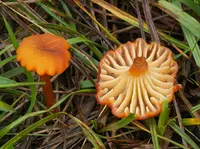
Bog waxcap, Hygrocybe coccineocrenata, is a small, waxy cap fungus rather than a leafy plant. It typically forms bright red to orange caps with a slender, pale stem and a moist, slightly greasy surface.
This species usually appears in wet, nutrient-poor habitats such as bogs, peaty grasslands, and mossy ground, often in cool, clean environments. It tends to be sensitive to disturbance and pollution, which makes it harder to cultivate or maintain in managed spaces.
To care for bog waxcap in a garden-style setting, conditions must mimic its natural habitat, with consistently damp, low-nutrient, mossy substrates and minimal soil disturbance.

Care Difficulty
Hard Care

Light Preference
Partial Shade

Water Requirements
Keep Soil Moist

Temperature Preference
Cool Climate

Hardiness Zone
Unknown

Soil Texture
Peaty, Organic-rich, Loamy

Soil pH
Strongly acidic (4.5–5.5), Acidic (5.5–6.5)

Soil Drainage
Moist but well-drained

Fertilization
Minimal (feed rarely)
Scan your plant to receive care tips personalized for your specific plant
Available on iOS and Android
This woodland fungus prefers cool, moist, low-light habitats with only brief sun exposure.
This species depends on consistently moist, boggy ground rather than direct watering of the fruiting bodies.
This fungus is adapted to cool, moist climates and fruits best in moderate temperatures.
This fungus requires consistently moist, cool air and substrate, so humidity is important for reliable fruiting.
This species fruits on persistently damp, nutrient-poor, acidic substrates rather than typical garden soil.
This species is poorly suited to containers and rarely performs reliably outside its natural bog habitat, so container culture is not recommended.
This fungus grows in nutrient-poor, mossy bogs and generally should not be fertilized in cultivation.
Hygrocybe coccineocrenata does not require pruning, as its fruiting bodies are temporary and the main organism lives hidden in the soil.
This species is not suited to standard container culture, so management focuses on carefully transplanting habitat patches rather than repotting individual specimens.
In practice, Hygrocybe coccineocrenata is not propagated by home growers, as it forms complex relationships with its bog habitat and microorganisms.
In natural bogs this species overwinters in the soil and usually needs no special winter care beyond maintaining its habitat.

Plant Health Check
Not sure what's wrong with your plant? Check your plant's health inside the app.
The fruiting bodies have vivid scarlet to orange-red caps that often show a finely scalloped or crenulated margin when mature, which helps separate this species from smoother-margined red waxcaps.
This species is typically found in wet acidic habitats such as bogs, flushes, and saturated grasslands, rather than the drier old grassland sites favored by many other waxcaps.
Records are concentrated in cool, oceanic climates of northern and western Europe, especially in the British Isles and Scandinavia, where it is considered a characteristic fungus of intact, nutrient-poor bog systems.
This species is generally regarded as inedible. It is small, insubstantial, and not used as food. Identification of waxcap species is difficult, so foraging is discouraged due to the risk of confusion with other fungi.
Keep your plants happy and healthy with plant identification, disease detection, and easy care guidance.

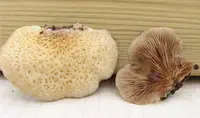
Crepidotus calolepis
Crepidotus calolepis
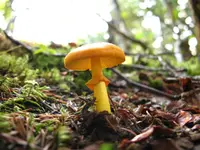
Peck's Yellow Dust Amanita
Amanita elongata
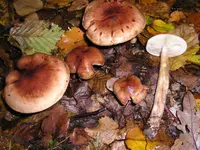
Birch Knight
Tricholoma fulvum
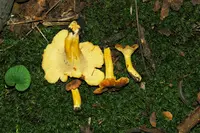
Cantharellus appalachiensis
Cantharellus appalachiensis
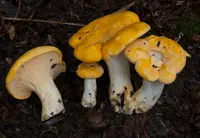
Ghost chanterelle
Cantharellus phasmatis
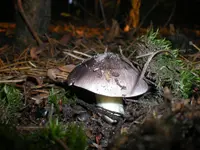
Sticky Gray Trich
Tricholoma portentosum
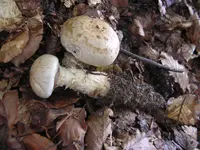
rooting poisonpie
Hebeloma radicosum
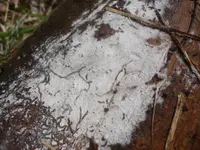
Botryobasidium subcoronatum
Botryobasidium subcoronatum