

Use clean inoculum
When introducing this fungus to a new site, use spawn or spore slurries taken from healthy, mature caps only and avoid mixing in soil from unknown locations to reduce the risk of bringing in competing fungi or soil pathogens.

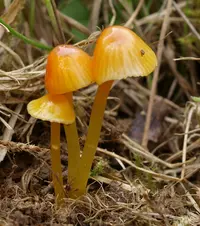
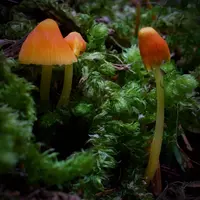
Glutinous waxcap, Hygrocybe glutinipes, is a small, gelatinous mushroom rather than a traditional leafy plant. It produces slender, sticky stems with smooth, often bright caps that look moist or glossy. The fruiting bodies appear in short-lived flushes rather than forming long-term structures.
This species typically grows in unimproved grasslands, mossy lawns, or open woodland edges, mostly in cool, damp climates. It depends on low-nutrient, undisturbed soils, which makes it challenging to cultivate at home.
Anyone wanting to care for Glutinous Waxcap should know it prefers consistently moist conditions, clean air, and soil that has not been heavily fertilized or treated with chemicals.

Care Difficulty
Hard Care

Light Preference
Partial Shade

Water Requirements
Keep Soil Moist

Temperature Preference
Cool Climate

Hardiness Zone
Unknown

Soil Texture
Loamy, Silty, Organic-rich

Soil pH
Strongly acidic (4.5–5.5), Acidic (5.5–6.5)

Soil Drainage
Moist but well-drained

Fertilization
Minimal (feed rarely)
Scan your plant to receive care tips personalized for your specific plant
Available on iOS and Android
This woodland fungus prefers soft, cool light rather than strong, direct sun.
This species depends more on consistently moist habitat than on direct watering intervention.
This fungus is adapted to mild, temperate conditions and fruits best in cool seasons.
This woodland fungus prefers consistently moist air but does not require strict humidity control outdoors.
This species requires a moist, well-aerated, undisturbed soil that supports its natural fungal associations.
This species is generally unsuitable for container growing because it relies on complex soil and microhabitat conditions that pots rarely provide.
Hygrocybe glutinipes is a wild, mycorrhiza-associated fungus that should not be fertilized in garden settings.
Hygrocybe glutinipes does not require pruning, since only short-lived fruiting bodies are visible above ground.
Transplanting is rarely appropriate because this fungus depends on undisturbed soil and specific symbiotic partners.
Artificial propagation of Hygrocybe glutinipes is technically challenging and not recommended for home growers.
Outdoor colonies are naturally cold hardy and need no special winter care in typical temperate climates.

Plant Health Check
Not sure what's wrong with your plant? Check your plant's health inside the app.
The cap surface is notably slimy or glutinous when moist, a feature that helps distinguish this species from many other small red waxcaps with drier caps.
This fungus is typically found in old, unimproved grasslands with low nutrient levels, and its presence can indicate long-term, minimally fertilized habitats in parts of Europe and North America.
The gills are relatively thick, widely spaced, and often somewhat waxy, reflecting the characteristic hymenial structure of waxcaps while still allowing easy identification by their loose attachment and texture.
This waxcap is generally regarded as inedible or of no culinary value. Identification of small fungi is difficult, and some similar species are toxic. For safety, it is best not to eat it at all.
Keep your plants happy and healthy with plant identification, disease detection, and easy care guidance.

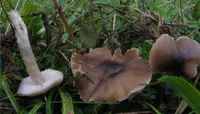
Common Crazed Cap
Dermoloma cuneifolium
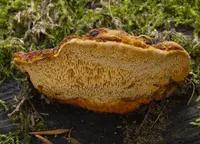
Anise Mazegill
Gloeophyllum odoratum
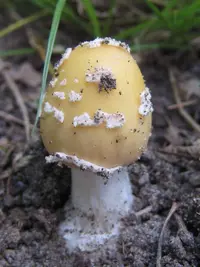
Great Funnel-Veil Amanita
Amanita velatipes
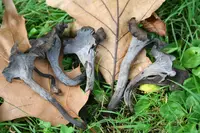
Horn-of-plenty
Craterellus cornucopioides
Cerioporus mollis
Cerioporus mollis
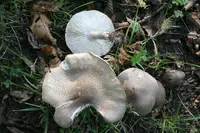
Tricholoma scalpturatum
Tricholoma scalpturatum
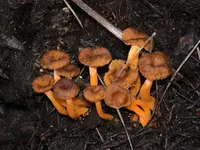
Cantharellus xanthopus
Cantharellus lutescens
tangerine bonnet
Atheniella aurantiidisca