Moss layer management
Maintain a thin, living moss layer over the substrate to retain moisture but trim or gently peel it back in patches if it starts to smother emerging fruiting bodies so caps can break through cleanly.

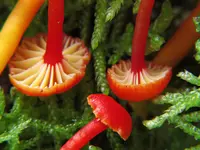
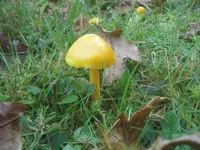
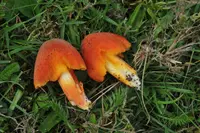
Spangle waxcap (Hygrocybe insipida) is a small, grassland mushroom rather than a leafy houseplant. It produces slender stems topped with smooth, often pale orange to yellow caps that can look slightly translucent when moist. The fruiting bodies are usually scattered or in small groups rather than dense clusters.
This species typically occurs in unimproved meadows, lawns, and short turf, especially in nutrient-poor, undisturbed grasslands across parts of Europe and other temperate regions. It is considered sensitive to soil disturbance, heavy fertilizing, and habitat loss, which makes it challenging to cultivate deliberately. Gardeners who wish to care for Spangle Waxcap must maintain low-nutrient, well-drained grass areas and avoid excessive mowing or soil enrichment.

Care Difficulty
Hard Care

Light Preference
Partial Shade

Water Requirements
Keep Soil Moist

Temperature Preference
Cool Climate

Hardiness Zone
Unknown

Soil Texture
Loamy, Silty, Organic-rich

Soil pH
Strongly acidic (4.5–5.5), Acidic (5.5–6.5)

Soil Drainage
Moist but well-drained

Fertilization
Minimal (feed rarely)
Scan your plant to receive care tips personalized for your specific plant
Available on iOS and Android
This grassland fungus prefers soft, indirect light rather than intense direct sun.
This waxcap relies on consistently moist but not waterlogged grassland soil.
This species fruits best in cool to mild conditions rather than summer heat.
Humidity is not a major controllable factor for Hygrocybe insipida, which fruits outdoors in naturally moist habitats rather than indoor environments.
This fungus relies on naturally moist, undisturbed, low-nutrient soils rather than conventional potting mixes.
Hygrocybe insipida is not suitable for container growing, as it depends on complex soil ecosystems that standard pots cannot provide.
Hygrocybe insipida typically grows in low-nutrient grassland and does not benefit from routine fertilization in cultivation.
Hygrocybe insipida does not require structural pruning, only simple tidying of fruiting bodies.
This fungus is rarely grown in containers; management focuses on transplanting or maintaining suitable grassland rather than classic repotting.
Propagation of Hygrocybe insipida is challenging and usually relies on natural spore dispersal within suitable grassland.
Spangle Waxcap is cold hardy in temperate climates and generally needs no special winter care once established in appropriate grassland.

Plant Health Check
Not sure what's wrong with your plant? Check your plant's health inside the app.
This species produces very small, slender fruiting bodies, typically with caps only a few millimeters to around 1 cm across, which makes it easy to overlook among mosses and leaf litter.
It is strongly associated with moist, moss-rich microhabitats, often appearing scattered among moss in unimproved grasslands, woodland clearings, or damp soil that has not been heavily fertilized.
The caps range from pale yellow to orange-red but are usually rather dull and translucent, with the color often fading quickly as the fruiting body ages or dries, which contributes to its inconspicuous nature compared with more vivid waxcaps.
This small waxcap mushroom is generally regarded as inedible, mainly due to its tiny size, insubstantial flesh, and limited culinary value. It is not known to be dangerously toxic, but it is not recommended for consumption.
Keep your plants happy and healthy with plant identification, disease detection, and easy care guidance.