Host tree selection
Establish colonies near healthy spruce or fir roots, since this mycorrhizal fungus depends on conifer partners and will fruit more reliably where fine feeder roots are dense and undisturbed.

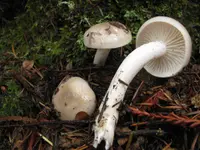
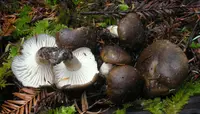
Almond woodwax, Hygrophorus agathosmus, is a gilled mushroom rather than a leafy plant, known for its pale gray cap and distinct sweet, almond-like scent. It usually appears in small groups on forest floors.
This species is native to coniferous and mixed woodlands across temperate regions of Europe and North America, often fruiting in mossy, damp areas. Its growth is seasonal and depends strongly on moisture and suitable tree partners.
Because it forms symbiotic relationships with trees, it cannot be easily cultivated at home, so direct attempts to care for Almond woodwax are rarely successful. It prefers cool, humid habitats and undisturbed, well-drained forest soil rich in organic matter.

Care Difficulty
Hard Care

Light Preference
Shade

Water Requirements
Regular Water

Temperature Preference
Cool Climate

Hardiness Zone
Unknown

Soil Texture
Loamy, Silty, Organic-rich

Soil pH
Acidic (5.5–6.5), Slightly acidic (6.5–7.0)

Soil Drainage
Moist but well-drained

Fertilization
Minimal (feed rarely)
Scan your plant to receive care tips personalized for your specific plant
Available on iOS and Android
This woodland mushroom prefers cool, subdued light similar to a shaded forest floor.
This fungus relies on consistently moist, not waterlogged, soil around its tree partners.
This species thrives in cool to mild conditions typical of temperate forests.
This forest mushroom prefers consistently moist air in cool, sheltered conditions.
This fungus fruits best in loose, aerated, humus-rich soil under compatible trees rather than in a conventional potting mix.
This ectomycorrhizal mushroom is generally unsuitable for long-term container cultivation because it depends on living tree roots.
Hygrophorus agathosmus is a mycorrhizal fungus that gains nutrients through its tree partners, so direct fertilization is usually unnecessary for healthy growth.
Hygrophorus agathosmus does not need pruning in the horticultural sense, but some light cleanup supports observation and hygiene in the patch.
This fungus forms symbiotic mycorrhizae with host trees, so repotting or transplanting focuses on its habitat rather than the organism itself.
Practical propagation of Hygrophorus agathosmus is challenging because it depends on a close association with host tree roots.
In native climates this cold-hardy species needs no special winter care, as its main body remains insulated in the soil while fruiting bodies disappear.

Plant Health Check
Not sure what's wrong with your plant? Check your plant's health inside the app.
Fresh fruitbodies produce a distinct almond or bitter almond scent caused by volatile aromatic compounds, which makes this mushroom easy to recognize in the field by smell alone.
This fungus forms ectomycorrhizal associations specifically with spruce trees, especially Norway spruce, exchanging mineral nutrients from the soil for sugars produced by its host.
It typically fruits in late summer to autumn in cool, moist conifer forests, often appearing in the same spruce stands year after year when weather conditions remain similar.

Although considered edible in some European field guides, this species is usually collected more for its distinctive odor and value in field identification than as a culinary mushroom, and it is often left in place to support forest nutrient cycling and spruce health.
This mushroom is generally regarded as edible but is not widely collected due to its small size, slimy cap, and limited culinary value. Always confirm identification with an expert before consumption, as confusion with toxic species is possible.
Keep your plants happy and healthy with plant identification, disease detection, and easy care guidance.