Hygrophorus persoonii Care

Hygrophorus persoonii

About Hygrophorus persoonii

Hygrophorus persoonii is not a leafy houseplant but a wild mushroom species, typically found in forests rather than in homes or gardens. It forms fleshy, medium-sized fruiting bodies, often with a slimy or moist cap surface, and grows from soil rich in leaf litter. This fungus occurs mainly in temperate regions of Europe, associated with broadleaf trees such as beech and oak.

It is an ectomycorrhizal species, meaning it forms a nutrient-exchanging partnership with tree roots, so it cannot be cultivated like a normal potted plant. Any attempt to care for Hygrophorus persoonii focuses on preserving its woodland habitat, including undisturbed soil, natural leaf litter, and stable moisture levels.

Main Plant Requirements

Care Difficulty

Moderate Care

Light Preference

Partial Shade

Water Requirements

Moderate Water

Temperature Preference

Cool Climate

Hardiness Zone

Unknown

Soil Texture

Loamy, Silty, Organic-rich

Soil pH

Acidic (5.5–6.5)

Soil Drainage

Moist but well-drained

Fertilization

Minimal (feed rarely)

Get Personalized Care Plan

Scan your plant to receive care tips personalized for your specific plant

Available on iOS and Android

How to Care for the Hygrophorus persoonii

This woodland fungus prefers low to moderate light that mimics a shaded forest floor.

  • Provide bright shade or dappled light under trees, with no more than 1–2 hours of weak morning sun and full protection from harsh midday and afternoon sun.
  • Site Hygrophorus persoonii where it receives indirect light; heavy shade slows fruiting, while direct sun dries the substrate and can kill mycelium near the surface.
  • In summer, increase shade cover if light feels hot on the hand; in late autumn, more open canopy is acceptable as sun intensity is lower.

This species needs consistently moist, not waterlogged, conditions similar to a cool, humus-rich forest floor.

  • Maintain evenly moist soil or leaf litter, allowing only the top 1–2 cm to start drying before rewetting the area with a gentle soak.
  • Ensure excellent drainage; standing water or sour, swampy odors indicate overwatering and risk of mycelium rot, while crisp, curling leaves or cracking soil signal underwatering nearby plants in the habitat.
  • Increase moisture input during warm, windy periods and main fruiting season, then reduce slightly in cooler months while never allowing the substrate to become completely dry.

This fungus favors cool to mild conditions typical of temperate woodlands.

  • Aim for a general range of 45–68°F (7–20°C) during active growth and fruiting, with the most reliable development often around 50–60°F (10–16°C).
  • Tolerates brief drops close to 32°F (0°C) but prolonged hard frost can damage fruiting bodies, so a protective leaf-litter layer helps buffer sudden cold snaps.
  • Sustained temperatures above 75°F (24°C) slow or stop fruiting; partial shade and a thick organic mulch help keep the soil cooler during late-summer heat.

Humidity plays little role in cultivation because this mushroom is not realistically managed as a household plant.

In gardens, Hygrophorus persoonii is not practically managed through soil preparation, as it is a mycorrhizal mushroom relying on tree root associations.

  • Avoid disturbing the existing soil structure around host trees, since heavy digging or rototilling can disrupt the fungal network.
  • Do not add dense, clayey fill or construction debris over the root zone, which can impede gas exchange and water movement.
  • Limit fresh, high-salt fertilizers near host trees, as these can stress roots and indirectly reduce fungal fruiting.
  • Maintain a loose, leaf-litter surface layer rather than thick synthetic mulches, which supports natural moisture and aeration patterns.

This species is not suitable for container growing, since it depends on living tree roots in natural soil.

This woodland fungus does not need routine fertilizing when growing in a natural soil ecosystem with host trees.

As a wild mycorrhizal fungus, Hygrophorus persoonii does not require pruning in cultivation or habitat management.

This species is not suited to typical container culture, so focus on careful habitat-aware transplanting only when essential for research or conservation.

  • Move small soil blocks rather than bare mycelium to keep fungal threads intact and reduce stress.
  • Transplant during cool, moist weather in autumn to maintain high soil humidity and stable temperatures.
  • Shift material only short distances within similar woodland conditions and compatible tree hosts.
  • Avoid frequent disturbance; allow several years between any necessary relocations to let the fungus re-establish.

Practical propagation of Hygrophorus persoonii is difficult and not routinely performed by home growers.

In its natural range this fungus is cold hardy and usually needs no specific winter care beyond conserving its woodland habitat.

Care Tips

Host tree focus

Survey nearby broadleaf trees and focus on protecting mature oaks or beeches, since this fungus is mycorrhizal and fruiting will be far more reliable near stable, undisturbed host roots.

Minimal soil disturbance

Avoid raking, tilling, or heavy foot traffic where the mushrooms appear, because repeated disturbance can damage the underground mycelium and reduce future fruiting.

Leaf litter management

Maintain a light, continuous layer of naturally fallen leaves under host trees instead of removing them, as this helps retain moisture and provides the organic environment this species prefers.

Gentle harvesting technique

Cut mushrooms at the base with a clean knife rather than pulling them up, so the mycelium network stays intact and has a better chance of producing more fruiting bodies in the same area.

Seasonal moisture support

During extended dry periods in autumn, apply a gentle, low-pressure watering to the leaf litter around host trees in the evening to mimic natural rainfall and support growing Hygrophorus persoonii without waterlogging the soil.

Common Pests and Diseases

Mycophagous springtails

These insects feed on fungal tissue and can graze on caps and gills, leaving small pits or surface scarring on fruiting bodies. Symptoms include slightly deformed or blemished mushrooms, especially in moist, organic litter where the fungus develops.

Solution

Collect and remove heavily infested or damaged fruiting bodies and reduce excessive surface moisture in the surrounding litter by improving drainage and gentle aeration of the site. Avoid piling dense, wet leaf layers, and if necessary use fine mesh or physical barriers around monitored patches to limit access from dense springtail populations while still allowing natural airflow.

Fungus gnat larvae

This pest develops in moist soil and leaf litter and its larvae can tunnel into developing fungal tissue, causing soft spots, internal galleries, and premature decay. Symptoms include small entry holes, water-soaked areas, and faster breakdown of caps and stems.

Solution

Remove and dispose of infested fruiting bodies and avoid chronically waterlogged microsites by improving drainage and moderating irrigation or other water sources nearby. Where monitoring is possible, reduce organic debris thickness and encourage slightly better airflow; in small protected culture trials, yellow sticky traps can help reduce adult gnats before they lay eggs around Hygrophorus persoonii.

Slugs and snails

These mollusks scrape and consume the soft fruiting bodies, often leaving large irregular bite marks and slime trails on caps and stems. Symptoms include rapidly disappearing mushrooms or heavily shredded caps soon after emergence.

Solution

Hand-pick slugs and snails in the evening or early morning and remove sheltering debris such as dense boards, stones, or plastic near fruiting patches. If close observation sites are maintained for growing Hygrophorus persoonii, low, coarse barriers such as copper tape on small frames or carefully positioned shallow beer traps can reduce local feeding pressure without disturbing the surrounding woodland ecosystem.

Mite grazing damage

These tiny arthropods can feed on the surface of caps and gills, leaving a fine, roughened texture and small pale patches. Symptoms include slightly dulled cap surfaces, shallow pitting, and sometimes a fine dusting of mite bodies or cast skins on nearby litter.

Solution

Remove and discard fruiting bodies that show advanced surface damage and avoid creating stagnant, overly humid pockets in observation areas by allowing moderate air movement through low vegetation and litter. In small-scale study or demonstration plots, fine mesh covers placed a few centimeters above the ground can physically reduce mite movement onto young mushrooms while still allowing natural rainfall and spore dispersal.

Bacterial spotting

This disease is caused by opportunistic bacteria that colonize moist, damaged caps, leading to small, water-soaked, dark spots that may spread into slimy lesions. Symptoms include localized softening, discoloration, and a wet, sometimes slightly odorous surface on affected tissue.

Solution

Carefully remove and dispose of spotted or slimy fruiting bodies to limit spread to nearby mushrooms and avoid handling caps with dirty or contaminated tools that can transfer bacteria. Improving micro-airflow by avoiding compacted, waterlogged litter and minimizing direct splashing from nearby irrigation or runoff lowers surface wetness duration and helps reduce new infections, which supports more stable Hygrophorus persoonii care instructions in monitored habitats.

Interesting Facts

Autumn oak associate

This species forms ectomycorrhizal partnerships with oaks, especially Quercus ilex and other Quercus species, and is most often found fruiting beneath them in late autumn and early winter.

Cap color changer

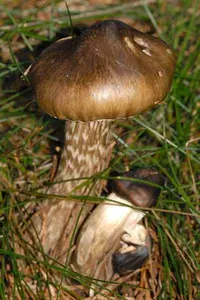
Its cap surface is slimy when moist and shows a distinctive color shift from violet-brown or gray-brown in youth to more uniformly brown or gray tones as it ages, which helps distinguish it from closely related Hygrophorus species.

Subtle violet staining

The gills and flesh can show faint violet or lilac tints, particularly in younger fruitbodies or when moist, a useful microscopic and field character noted by European mycologists when identifying this taxon.

Botan icon

Did you know?

Molecular studies have linked this species to a tight group of Mediterranean and European oak-associated Hygrophorus, and its precise delimitation has been important for clarifying the taxonomy of several superficially similar, long-confused waxcap-like mushrooms.

FAQs about Hygrophorus persoonii

This mushroom is considered edible but of modest culinary value. It should only be collected by experienced foragers who can confidently distinguish it from similar species. Always cook thoroughly and avoid polluted or contaminated collection sites.

Grow Healthy Plants with Botan Care

Keep your plants happy and healthy with plant identification, disease detection, and easy care guidance.

Botan plant care app — identify plants on mobile

Explore More Plants