

Substrate depth management
Use extra-deep trays or bags (20–30 cm) so the long rooting stem can develop fully without kinking, which reduces deformation and contamination risk at the buried portion.

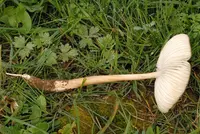
Deep root mushroom, Hymenopellis radicata, is a saprophytic fungus that lives on decaying roots and buried wood, not a true houseplant. It produces a slender, pale to tan cap on a long stem, with a characteristically elongated root-like base that penetrates deep into the soil. In nature it is found in grasslands, lawns, and open woodlands, especially where old tree roots remain underground.
This species depends on buried woody material and consistent moisture, which makes it difficult to manage in typical containers. Those who want to learn how to care for deep root mushroom generally focus on replicating its cool, humid, shaded forest-floor conditions with well-drained but organic-rich substrates.

Care Difficulty
Hard Care

Light Preference
Shade

Water Requirements
Keep Soil Moist

Temperature Preference
Cool Climate

Hardiness Zone
Unknown

Soil Texture
Loamy, Silty, Organic-rich

Soil pH
Acidic (5.5–6.5)

Soil Drainage
Moist but well-drained

Fertilization
Minimal (feed rarely)
Scan your plant to receive care tips personalized for your specific plant
Available on iOS and Android
This woodland fungus prefers low, dappled light similar to a shaded forest floor.
Moist, well‑aerated ground is essential for sustained Hymenopellis radicata fruiting.
This species fruits best in cool to mild conditions typical of temperate woodlands.
This fungus prefers moderately moist air but adapts to a broad humidity range outdoors.
Hymenopellis radicata grows best in loose, organic-rich substrate that mimics decaying wood and forest soil.
This species is only moderately suitable for container growing, mainly for experimental or educational setups.
Hymenopellis radicata naturally supports its growth on decaying organic matter and usually needs no added fertilizer in garden or woodland settings.
Hymenopellis radicata does not require structured pruning, but limited hygiene removal can support healthy surrounding vegetation and reduce decay clutter.
This fungus is rarely maintained as a potted specimen; management focuses on relocating colonized substrate rather than conventional repotting.
Establishing new colonies is possible but technical, so routine home propagation is not recommended for beginners.
This species is naturally cold hardy in temperate climates and needs no special winter care in the ground.

Plant Health Check
Not sure what's wrong with your plant? Check your plant's health inside the app.
This fungus forms an unusually long, root-like stem extension that can penetrate deep into compact soil and decaying roots, a feature that inspired both its common name and the specific epithet radicata, meaning rooted.
It typically fruits from buried hardwood roots or stumps rather than exposed logs, so the visible cap and upper stem often appear to emerge directly from grass or soil in lawns and pastures.
Mature caps develop a characteristically finely wrinkled or radially lined surface that helps distinguish it from superficially similar lawn mushrooms with smoother caps.

Genetic and microscopic studies have shown that this species (formerly placed in genera such as Xerula and Oudemansiella) is distinct enough in its features and evolutionary lineage to justify placement in the separate genus Hymenopellis, reflecting a refined understanding of its relationships within the Physalacriaceae family.
This fungus is considered inedible. The flesh is thin, tough, and not suitable for culinary use, even though it is not strongly poisonous. It is best treated as a woodland curiosity rather than food.
Keep your plants happy and healthy with plant identification, disease detection, and easy care guidance.

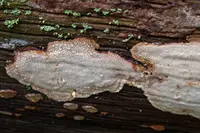
Anthoporia
Anthoporia albobrunnea
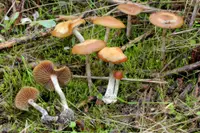
wavy cap
Psilocybe cyanescens
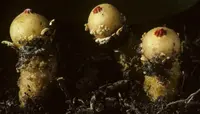
Collared Calostoma
Calostoma lutescens
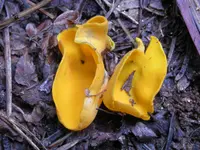
Spring Orange Peel Fungus
Caloscypha fulgens
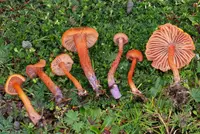
Bicoloured Deceiver
Laccaria bicolor
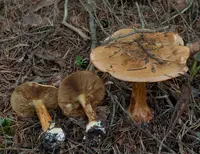
Calonarius sulfurinus
Calonarius sulfurinus
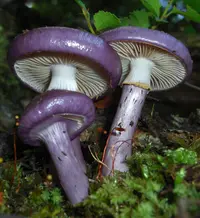
Cortinarius magellanicus
Cortinarius magellanicus
psychedelic ovoid mushroom
Psilocybe ovoideocystidiata