

Substrate rotation
If cultivating this fungus on woody debris, rotate and partially replace the branch or bark pieces every 12–18 months to maintain a fresh food source and reduce buildup of competing molds.

Hymenotorrendiella clelandii is a small, wood-inhabiting fungus rather than a leafy plant. It typically appears as fine, dark, pin-like fruiting bodies scattered over decaying wood or bark. The overall look is subtle and often overlooked in natural settings.
This species is known from forested areas in parts of Australia, where it plays a role in breaking down dead plant material. It is not commonly grown in cultivation, and information on how to care for Hymenotorrendiella clelandii in garden or indoor settings is very limited.
In theory, it would prefer cool, consistently moist, shaded conditions and access to suitable dead wood, but it is mainly of interest to mycologists and fungal enthusiasts rather than home growers.

Care Difficulty
Moderate Care

Light Preference
Partial Shade

Water Requirements
Moderate Water

Temperature Preference
Warm Climate

Hardiness Zone
Unknown

Soil Texture
Loamy

Soil pH
Slightly acidic (6.5–7.0)

Soil Drainage
Well-drained

Fertilization
Minimal (feed rarely)
Scan your plant to receive care tips personalized for your specific plant
Available on iOS and Android
This fungus prefers bright, indirect forest-like light rather than intense open sun exposure.
Moisture conditions in the substrate and surrounding environment are more critical than direct watering for this fungus.
This species favors mild, stable conditions without strong temperature extremes.
This species tolerates a broad humidity range and rarely needs special humidity management in cultivation.
This fungus develops on organic debris rather than in conventional potting soil, so soil preparation focuses on recreating a moist, decaying substrate.
This species is not suitable for typical container growing, as it depends on natural organic debris and host material rather than a potting environment.
This wood-inhabiting fungus is usually not fertilized, as Hymenotorrendiella clelandii obtains nutrients directly from decaying plant material.
Pruning is not applicable because the fungus does not form woody stems or foliage that benefit from structural cutting.
This species is not managed as a potted or garden plant, so transplanting focuses on relocating colonized substrate rather than the organism itself.
Propagation of this fungus is rarely attempted in home or ornamental settings and is usually left to natural spore dispersal.
Specific winter care is not needed, as the fungus persists within its woody substrate and follows natural seasonal cycles.

Plant Health Check
Not sure what's wrong with your plant? Check your plant's health inside the app.
This species forms tiny, black, disc-like fruiting bodies (ascomata) on twigs and small branches, which are often only visible with close inspection or a hand lens.
It has been recorded mainly on dead or dying twigs of Eucalyptus species in Australia, indicating a strong association with these native trees as a saprobe that recycles woody material.
The species was originally described in another genus and later transferred to Hymenotorrendiella based on microscopic features of its spores and asci, reflecting advances in understanding of its relationships within the Helotiales.
This fungus is not considered edible. It is small, inconspicuous, and poorly studied from a culinary perspective. It should be treated as inedible, and collection for food is not recommended due to limited toxicity data.
Keep your plants happy and healthy with plant identification, disease detection, and easy care guidance.

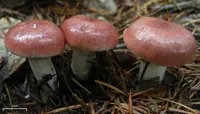
Rosy Slime Spike
Gomphidius subroseus
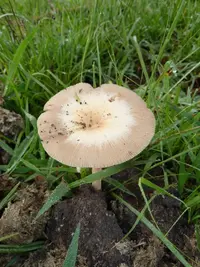
Bolbitius coprophilus
Bolbitius coprophilus
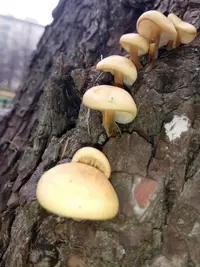
Flammulina populonica
Flammulina populicola
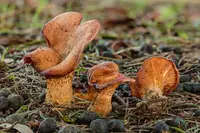
tawny funnel cap
Paralepista flaccida
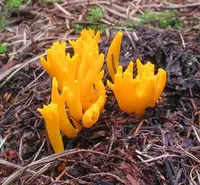
Jelly-antler
Calocera viscosa
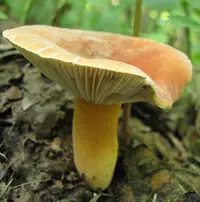
Lactifluus hygrophoroides
Lactifluus hygrophoroides
Hymenotorrendiella eucalypti
Hymenotorrendiella eucalypti
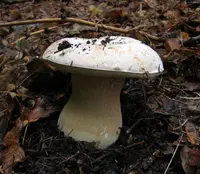
Barrow's Bolete
Boletus barrowsii