Spore-friendly raking
Lightly rake and loosen the upper 1–2 cm of leaf litter once fruiting bodies have decayed so spores can contact the soil surface and establish new mycelial points without disturbing tree roots.

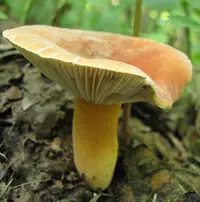
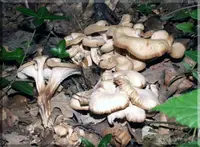
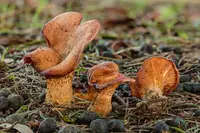
Lactifluus hygrophoroides is a mycorrhizal fungus, not a leafy houseplant. It forms a symbiotic relationship with tree roots, helping them absorb water and nutrients. The fruiting bodies appear as fleshy, funnel-shaped mushrooms with pale to orange-brown caps and closely spaced gills.
This species is typically found in forests of eastern North America, growing on the ground among leaf litter, often near oaks and other hardwoods. It depends on living trees, so it does not adapt well to pots or indoor culture.
Because of its tight link to host trees and soil fungi, it is considered challenging for those who want to care for Lactifluus hygrophoroides at home. It prefers stable woodland conditions with undisturbed soil and consistent moisture.

Care Difficulty
Moderate Care

Light Preference
Partial Shade

Water Requirements
Keep Soil Moist

Temperature Preference
Warm Climate

Hardiness Zone
Unknown

Soil Texture
Loamy, Silty, Organic-rich

Soil pH
Acidic (5.5–6.5)

Soil Drainage
Moist but well-drained

Fertilization
Minimal (feed rarely)
Scan your plant to receive care tips personalized for your specific plant
Available on iOS and Android
This ectomycorrhizal fungus prefers dappled forest light rather than direct, open sun.
Moist, never waterlogged soil is essential because this species depends on healthy, aerated tree-root zones.
This fungus favors temperate woodland conditions with cool to mild seasonal variation.
This ectomycorrhizal mushroom relies on naturally moist forest air rather than controlled humidity.
This fungus depends on specific outdoor forest soil conditions rather than a prepared potting substrate.
This species is not suitable for container growing, as it relies on extensive mycorrhizal associations with tree roots in undisturbed soil.
This wild mycorrhizal fungus does not need direct fertilization and relies on nutrients exchanged with its host trees, so soil enrichment should stay minimal.
As a forest-dwelling mushroom, Lactifluus hygrophoroides is not pruned; management focuses on habitat rather than the fungus itself.
This species forms symbiotic relationships with tree roots and is not suited to containers, so transplanting targets the host trees and overall site conditions.
Reproduction in this fungus depends on complex mycorrhizal development and spore dispersal, so practical home propagation is not recommended.
This temperate woodland fungus is naturally cold hardy in its native range and needs no specific winter care from gardeners.

Plant Health Check
Not sure what's wrong with your plant? Check your plant's health inside the app.
This species produces a white latex when injured that slowly turns yellow where it contacts the gills and flesh, a trait used by mycologists to distinguish it from similar milkcaps.
Its gills are unusually smooth, widely spaced, and strongly decurrent, meaning they run down the stalk, giving the underside of the cap a waxy, hygrophorus-like appearance that inspired the species name hygrophoroides.
It forms ectomycorrhizal partnerships with oaks in eastern North American forests, exchanging mineral nutrients and water from the soil for sugars from the tree, and it typically fruits on the ground near these hosts in summer and early autumn.
This mushroom is generally regarded as edible and is eaten in some regions, but correct identification is critical. It can be confused with inedible or mildly toxic look-alikes, so only consume specimens verified by an experienced mycologist.
Keep your plants happy and healthy with plant identification, disease detection, and easy care guidance.