Chicken Fat Mushroom Care (Suillus americanus)

Chicken Fat Mushroom

About Chicken Fat Mushroom

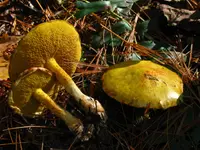
Chicken fat mushroom, Suillus americanus, is a mycorrhizal fungus that forms a mutual partnership with pine tree roots rather than living as a standalone plant. It produces bright yellow, slimy caps with small brownish spots and a spongy pore surface underneath instead of gills. This mushroom typically occurs in North America, especially in mixed and coniferous forests with eastern white pine. It often appears in groups on the ground, emerging from soil rich in pine litter. Suillus americanus is considered edible but is not favored by everyone due to its texture and strong coating. In cultivation, it is challenging because it needs a compatible pine host, so how to care for Chicken Fat Mushroom focuses mainly on keeping its tree partner healthy.

Main Plant Requirements

Care Difficulty

Moderate Care

Light Preference

Partial Shade

Water Requirements

Regular Water

Temperature Preference

Cold Hardy

Hardiness Zone

3–8

Soil Texture

Sandy, Loamy, Organic-rich

Soil pH

Strongly acidic (4.5–5.5), Acidic (5.5–6.5)

Soil Drainage

Moist but well-drained

Fertilization

Minimal (feed rarely)

Get Personalized Care Plan

Scan your plant to receive care tips personalized for your specific plant

Available on iOS and Android

How to Care for the Chicken Fat Mushroom

This ectomycorrhizal mushroom prefers bright, cool woodland conditions rather than exposed, open sun.

  • Provide dappled or filtered light under pine or mixed conifer canopy, equal to roughly 2–4 hours of gentle direct morning sun plus bright shade for the rest of the day.
  • Allow partial shade to light shade; Chicken Fat Mushroom fruiting often declines in dense, deep shade where little sky is visible.
  • Avoid intense midday and afternoon sun in open areas, which can overheat and dry the soil surface, reducing mycelium activity and fruiting, especially in late summer.

This species depends on consistently moist, not waterlogged, soil around its pine hosts.

  • Aim for soil that stays evenly moist in the top 5–8 cm, never fully drying out; use a handful test and water or irrigate when it feels just slightly damp, not wet.
  • During dry spells or hot summer periods, increase moisture around host pines with deep, infrequent irrigation rather than light, frequent sprinkling to support Suillus americanus mycelium.
  • Watch for overwatering signs such as sour smell, standing water, or slimy organic matter; underwatering shows as dusty, hydrophobic soil that repels water at the surface.

This mushroom fruits best in cool to mild conditions typical of temperate pine forests.

  • Optimal fruiting often occurs around 50–68°F (10–20°C), especially in cool, moist autumn weather after rains.
  • Mycelium can tolerate cooler soil, but hard frost below 28°F (-2°C) on exposed fruiting bodies can damage caps and shorten their lifespan.
  • Hot spells above 80°F (27°C) combined with dry air reduce fruiting; shading and maintained soil moisture buffer the habitat during summer heat.

Humidity is not a major factor for Suillus americanus compared with moisture in its substrate and surrounding soil.

Suillus americanus requires a specific outdoor soil environment because it forms a mycorrhizal partnership with pine roots.

  • Choose a loose, sandy to sandy-loam soil with high mineral content and moderate organic matter, similar to natural pine forest floors.
  • Ensure rapid drainage so water never pools; a consistently moist but never waterlogged upper layer best supports mycelium development.
  • Maintain slightly acidic conditions around pH 4.5–6.0, which favors both pine hosts and fungal growth.
  • Improve structure by lightly incorporating pine litter and well-decomposed compost into the top layer without disturbing nearby tree roots.

This species is not suitable for standard container growing because it depends on living pine roots in open ground.

Suillus americanus forms mycorrhizal partnerships with pines and typically needs no direct fertilization when growing in native, unfertilized soil.

Suillus americanus is not pruned in the usual garden sense, since the visible part is a temporary mushroom fruiting body.

This fungus is rarely grown in containers, so focus on establishing or transplanting its pine host rather than moving the mushroom itself.

  • Transplant young host pines in early spring or early fall, when temperatures are mild and soil is workable.
  • Choose a site with well-drained, slightly acidic soil and minimal previous disturbance to favor mycorrhizal development.
  • Water the pine thoroughly before and after transplanting to limit root stress and encourage new fine root growth.

Propagation of Suillus americanus is indirect and depends on spores and compatible pine hosts rather than standard plant techniques.

This species is naturally cold hardy in much of its range and needs no special winter protection when associated with hardy pine trees.

Care Tips

Pine Duff Substrate

When preparing an outdoor bed, mix well-aged pine needles and decayed pine duff into the top 5–10 cm of soil to better mimic the natural mycorrhizal habitat of this species.

Host Tree Selection

Establish culture only under compatible pine species (such as eastern white pine or similar 2-needle/5-needle pines) and avoid sites dominated by unrelated trees, since the fungus requires specific roots to form productive mycorrhizae.

Minimal Disturbance Zone

After colonization, mark a 60–90 cm ring around productive trees and avoid raking, tilling, or compacting this area so that the shallow fungal mycelium and fruiting primordia stay intact.

Seasonal Moisture Buffer

Spread a thin, airy layer of pine straw or coarse conifer mulch over the fruiting zone each spring to moderate surface drying while still allowing air flow to the developing mushrooms.

Clean Harvest Technique

Use a clean, sharp knife to cut mushrooms at the base rather than pulling, then gently press disturbed soil or duff back in place to protect remaining mycelium and support continued growing Chicken Fat Mushroom in the same spot.

Common Pests and Diseases

Parasitic boletes

This disease involves other bolete fungi parasitizing the fruiting bodies, causing distorted, discolored, or partially consumed caps and stems. Symptoms include uneven growth, off-colored patches, and rapid deterioration of the mushroom tissue.

Solution

Harvest and discard affected mushrooms as soon as distortions or discolored patches appear, and avoid eating parasitized specimens. Maintain good forest floor hygiene by not leaving heavily infected mushrooms on site, which limits spore buildup from the parasitic species in heavily used foraging areas.

Mycoparasitic molds

This disease is caused by molds that colonize the mushroom surface, leading to fuzzy, white, gray, or green growth and soft, water-soaked decay. Symptoms include rapid breakdown of the cap surface and unpleasant odor as the tissue decomposes.

Solution

Do not collect or consume moldy fruiting bodies and remove them from baskets or holding containers to prevent mold spread to healthy specimens. For short-term storage, keep harvested mushrooms cool, dry, and well ventilated to slow mold development and spoilage.

Fungivorous fly larvae

This pest consists of fly maggots that tunnel through the caps and stems, leaving small entry holes, brown tunnels, and crumbly or hollow tissue. Symptoms include mushrooms that feel unusually light, spongy, or riddled with internal damage when cut open.

Solution

Inspect each mushroom by slicing through the stem and cap; discard any specimens showing extensive tunneling or live larvae. Harvest younger, firm fruiting bodies early in the day and cool them quickly after collection to reduce egg hatch and larval development, which is a key part of how to take care of Chicken Fat Mushroom from a foraging and storage perspective.

Slug and snail feeding

These pests chew irregular holes in caps and stems, often leaving slime trails and frayed edges on the yellow surface. Symptoms include large missing sections of tissue and rapid aesthetic degradation, making mushrooms less suitable for harvest.

Solution

Collect mushrooms promptly when they emerge and prioritize intact, minimally damaged specimens. In managed garden or yard settings near pine hosts, reduce moist debris and dense groundcover that shelter slugs and snails, and hand-pick these mollusks in the evening to lower local feeding pressure.

Bacterial soft rot

This disease develops when bacteria invade water-stressed or physically damaged mushrooms, turning tissue slimy, foul-smelling, and translucent. Symptoms include wet, collapsing caps and stems that rapidly lose structure and become unfit for consumption.

Solution

Handle mushrooms gently during harvest to avoid bruising, and store them in breathable containers at cool temperatures to limit bacterial growth. Immediately discard any soft, slimy, or strongly odoriferous fruiting bodies, and keep sound mushrooms separate from decaying ones during transport and storage.

Interesting Facts

Bright cap staining

The cap surface often develops reddish to brown spots where handled or bruised, contrasting with its natural bright yellow color. This spotting is due to pigment oxidation in the sticky cap cuticle after physical damage.

Pine specialist fungus

This species forms ectomycorrhizal partnerships specifically with 2-needle pines such as eastern white pine, exchanging mineral nutrients for sugars from the tree. It is rarely found away from its pine hosts, which makes its distribution closely tied to these conifers.

Slimy cuticle adaptation

The thick, sticky layer on the cap helps reduce water loss and may protect the fruiting body from desiccation and some surface-feeding invertebrates. The slimy coating is especially noticeable in wet weather and can trap debris like pine needles.

Botan icon

Did you know?

Suillus americanus belongs to a group of fungi that often show host specificity, and experimental studies have demonstrated that its mycorrhizal association can improve pine seedling growth and survival in nutrient-poor, sandy soils by increasing access to phosphorus and other mineral nutrients.

FAQs about Chicken Fat Mushroom

This species is generally considered edible when properly cooked and correctly identified, but quality is variable and some people report digestive upset. Always avoid slimy, old, bug-infested, or bitter-tasting specimens and consult a reliable local field guide.

Grow Healthy Plants with Botan Care

Keep your plants happy and healthy with plant identification, disease detection, and easy care guidance.

Botan plant care app — identify plants on mobile

Explore More Plants