Retain Host Bark
When surveying or managing deadwood, leave the fungus-bearing bark intact on logs or branches so the crust can continue its slow colonization and spore production instead of drying out or flaking away prematurely.

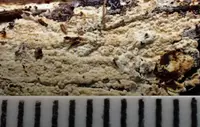
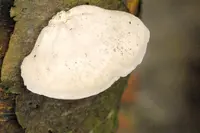
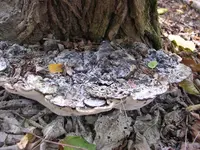
Hyphodontia alutaria is a crust-forming wood-decay fungus rather than a leafy houseplant. It forms thin, patchy, cream to pale ochre layers closely attached to dead wood. The surface is often smooth to slightly rough and lacks distinct caps or stems. Spores are produced on the exposed surface, giving it a fine, dusty look under magnification.
This species is typically found on dead conifer or hardwood branches in temperate forests, where it helps break down lignin and cellulose in wood. It is not commonly cultivated, and there is very little established guidance on how to care for Hyphodontia alutaria outside natural or research settings.

Care Difficulty
Moderate Care

Light Preference
Partial Shade

Water Requirements
Moderate Water

Temperature Preference
Warm Climate

Hardiness Zone
Unknown

Soil Texture
Loamy

Soil pH
Slightly acidic (6.5–7.0)

Soil Drainage
Well-drained

Fertilization
Minimal (feed rarely)
Scan your plant to receive care tips personalized for your specific plant
Available on iOS and Android
This wood-inhabiting fungus favors stable, subdued light rather than direct sun exposure.
Moisture management focuses on keeping the woody substrate evenly damp without standing water.
This species performs best in cool to mild conditions with limited temperature extremes.
Humidity is not a critical factor for Hyphodontia alutaria under typical outdoor conditions.
This fungus prefers consistently moist, well-drained, woody substrates or substrate-mimicking mixes.
This species is not well suited to conventional container growing because it naturally colonizes dead wood rather than soil-filled pots.
This wood-decaying fungus usually gains all nutrients from its host and surrounding organic matter, so Hyphodontia alutaria care rarely involves deliberate fertilization.
As a crust fungus living on dead wood, this species does not need horticultural pruning in the usual sense.
This species naturally colonizes dead wood in situ, so it is not managed through typical repotting or transplanting like a potted plant.
Propagation of this wild saprobic fungus is usually left to natural spore dispersal and is not a routine horticultural task.
In its natural outdoor habitat, this fungus is cold hardy and does not require targeted winter care.

Plant Health Check
Not sure what's wrong with your plant? Check your plant's health inside the app.
This species forms a thin, resupinate, crust-like basidiocarp tightly attached to dead wood, with a smooth to slightly uneven surface that can appear pale ochre to cream-colored when fresh.
Under magnification, the spore-bearing surface shows very fine aculei (minute spines), a key microscopic feature used by mycologists to separate it from other corticioid fungi.
It is a saprotrophic fungus that decomposes dead conifer and sometimes hardwood branches, contributing to nutrient cycling and wood decay in temperate forest ecosystems.
This corticioid wood-decay fungus is not considered edible or culinary. It is thin, tough, and lacks known nutritional or gastronomic value. Field guides usually list it as inedible rather than poisonous, so it should simply be avoided.
Keep your plants happy and healthy with plant identification, disease detection, and easy care guidance.