Yellow-green Russula Mold Care (Hypomyces luteovirens)

Yellow-green Russula Mold

About Yellow-green Russula Mold

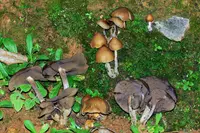
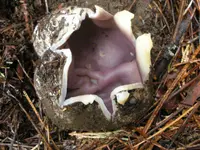
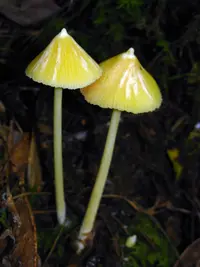
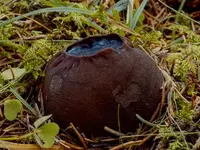
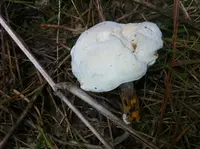
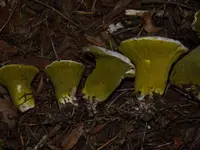
Yellow-green russula mold is not a true plant but a parasitic fungus that infects russula mushrooms. Hypomyces luteovirens forms a yellow to yellow‑green crust over its host, often changing the mushroom’s surface texture and color. It occurs mainly in temperate forests, especially in North America, where russula species are common. The fungus relies on its host for nutrients, so it cannot be grown in a typical garden or pot. Because it is specialized and host-dependent, it is challenging to cultivate intentionally, and most people encounter it only in the wild. For those studying fungi rather than home growers, learning how to care for Yellow-green Russula Mold focuses on understanding host availability and forest conditions.

Main Plant Requirements

Care Difficulty

Moderate Care

Light Preference

Partial Shade

Water Requirements

Regular Water

Temperature Preference

Cool Climate

Hardiness Zone

Unknown

Soil Texture

Loamy, Organic-rich

Soil pH

Slightly acidic (6.5–7.0)

Soil Drainage

Moist but well-drained

Fertilization

Minimal (feed rarely)

Get Personalized Care Plan

Scan your plant to receive care tips personalized for your specific plant

Available on iOS and Android

How to Care for the Yellow-green Russula Mold

Hypomyces luteovirens develops best on its russula host in cool, shaded woodland conditions rather than direct open sun.

  • Aim for dappled light or high shade, similar to a forest understory receiving 1–3 hours of weak, filtered sun per day, especially morning light rather than intense afternoon exposure.
  • Avoid full, open sun; prolonged direct sun over 3–4 hours can dry the host mushroom rapidly, reducing the visibility and vigor of Yellow-green Russula Mold.
  • In summer, increased canopy shade naturally protects it, while in early spring or late fall more direct light may reach the forest floor, so rely on leaf litter and nearby vegetation to diffuse light.

This fungus depends on consistently moist, but not waterlogged, forest litter and soil around its russula host.

  • Aim for evenly damp conditions; the top 1–3 cm of leaf litter should feel moist but not soggy, with visible sheen fading between rains rather than cracking dryness.
  • If monitoring a known Hypomyces luteovirens patch, note that shriveling or brittle host mushrooms suggest drought, while soft, collapsing, foul-smelling caps indicate prolonged saturation.
  • Choose substrates and microsites with good drainage, such as gentle slopes or well-structured forest soil, and expect naturally higher moisture needs during warm, dry periods compared with cool, wet seasons.

This species favors mild, temperate woodland conditions and is sensitive to prolonged extreme heat or hard frost.

  • Optimal development usually occurs around 55–70°F (13–21°C), matching typical late summer to fall forest temperatures in many temperate regions.
  • Growth slows markedly below about 45°F (7°C) and may cease with hard freezes, so fruiting and visible infection are mostly limited to frost-free periods.
  • Temperatures above 80°F (27°C), especially combined with drying winds, can desiccate the host mushrooms quickly; shaded, humid microsites help buffer short hot spells.

This parasitic fungus needs consistently very damp conditions to fruit well.

  • Maintain very high humidity at 80–95% by keeping host russula caps in enclosed, poorly ventilated spaces.
  • Dry air quickly halts growth; tissue shriveling and pale, patchy surfaces indicate humidity stress.
  • Raise humidity by misting the host substrate frequently, covering trays with clear plastic, or using a humidity tent while still allowing minimal air exchange.

This species develops on host russula mushrooms rather than in conventional soil, so the focus is on the substrate supporting those hosts.

  • Provide a deep layer of moist, organic-rich forest duff or leaf litter over a well-drained mineral base to host Hypomyces luteovirens indirectly.
  • Ensure the substrate remains evenly moist yet not flooded, as standing water promotes bacterial rot that destroys both russulas and the parasite.
  • Aim for slightly acidic conditions around pH 5.0–6.0, which favor russula development and thus support the fungal parasite.
  • Improve aeration by mixing coarse leaf fragments, small bark pieces, or wood chips into the organic layer while keeping particle size relatively uniform.

This species is not well suited to conventional container growing because it depends on living russula mushrooms as its host, which are difficult to maintain in pots.

This parasitic fungus grows on russula mushrooms in nutrient-rich forest litter and does not benefit from added fertilizer.

Pruning is not a standard practice for Hypomyces luteovirens because it is a parasitic fungus rather than a managed ornamental plant.

In cultivation, this species is best left undisturbed on its host substrate rather than moved like a typical potted plant.

  • Avoid transplanting colonies; disturbance often disrupts the relationship with the russula host and surrounding microflora.
  • If study or culture is needed, transfer a small section of infected host tissue with minimal handling and maintain similar moisture and temperature.
  • Use sterile tools and containers to limit contamination by competing fungi and bacteria.
  • Provide a stable, cool environment that mimics natural woodland conditions to reduce stress after any necessary transfer.

Propagation of Hypomyces luteovirens is specialized and mainly of interest to mycologists rather than home growers.

Outdoor colonies on wild russula hosts generally need no special winter care in temperate climates.

Care Tips

Use Host Substrate

In cultivation trials, inoculate fresh caps of suitable Russula hosts with clean Hypomyces material rather than trying to grow it on standard agar or potting media, since this species is an obligate parasite that requires its host tissue to develop normally.

Stage-Based Harvesting

If the goal is documentation or spore study, collect a few infected host caps at different stages of coverage and maturity, labeling each with date, host species, and habitat notes to build a clearer picture of the organism’s life cycle under your local conditions.

Clean Inoculation Tools

Always use flame-sterilized or alcohol-wiped blades and forceps when transferring tissue between Russula caps to reduce contamination from competing molds that can quickly overrun Hypomyces colonies.

Moisture-Controlled Storage

When storing infected material short-term for observation, keep caps in a loosely closed, breathable container (such as a paper bag inside a box) at cool, stable temperatures to avoid rapid desiccation or collapse from excess condensation.

Field Documentation Routine

Photograph host mushrooms and surrounding vegetation before collecting, and record GPS, soil type, and associated tree species so that future attempts at growing Yellow-green Russula Mold can target similar, high-success habitats.

Common Pests and Diseases

Host basidiomycete decline

This disease occurs when the russula or other host mushroom supporting the fungus begins to senesce or rot, leading to collapse and discoloration of the infected surface. Symptoms include soft, water‑soaked host tissue and patchy loss of the typical yellow‑green crust.

Solution

Remove and discard the entire infected host mushroom as soon as tissue becomes soft or foul‑smelling, since the mycoparasite depends on a healthy host for structure. Avoid storing collected material in sealed, humid containers for long periods; use breathable boxes and moderate refrigeration to slow host decay when studying or growing Hypomyces luteovirens.

Competing saprophytic molds

These fungi colonize the same russula host substrate and can overgrow or patchily replace the yellow‑green layer. This disease complex often appears as white, gray, or dark fuzzy growth on top of or alongside the normal smooth crust.

Solution

Isolate clean fragments of the yellow‑green surface away from visibly fuzzy or differently colored molds and place them on fresh, sterile medium or a new, clean host mushroom. Maintain good air circulation and moderate humidity to discourage fast‑growing opportunistic molds that favor stagnant, wet conditions during Hypomyces luteovirens care instructions.

Interesting Facts

Specialist on russula hosts

This fungus parasitizes the fruiting bodies of certain Russula mushrooms, especially yellow- to green-capped species, forming a dense mold-like layer over the gills and cap surface.

Color-transforming infection

When it colonizes its host, the mushroom surface often shifts to yellowish or greenish tones, and the original gill structure can become blurred or almost effaced as the parasite overgrows it.

Spores with distinctive ornamentation

Microscopic examination shows its ascospores have a characteristic surface ornamentation pattern, which mycologists use as one of the key traits to confirm Hypomyces luteovirens in the field and laboratory.

FAQs about Yellow-green Russula Mold

This fungus is not considered edible. It parasitizes russula mushrooms, replacing their tissue with its own. Identification is difficult, and similar molds may be harmful, so it is safest to avoid consumption entirely.

Grow Healthy Plants with Botan Care

Keep your plants happy and healthy with plant identification, disease detection, and easy care guidance.

Botan plant care app — identify plants on mobile

Explore More Plants