Retain Host Logs
Leave beech logs or large branches in partial shade rather than tidying them away, as stable, moist deadwood is essential for the fungus to colonize and fruit reliably.

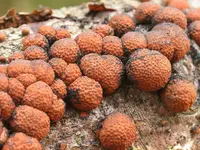
Beech woodwart is not a typical garden plant but a small wood-inhabiting fungus that grows mainly on dead or dying beech branches and trunks. Hypoxylon fragiforme forms hard, round to cushion-shaped crusts that are pinkish when young and turn dark brown as they age.
It occurs widely in temperate forests of Europe and North America, where it helps break down dead wood. The fungus is not usually cultivated, but those who care for Beech Woodwart should know it prefers shaded, humid woodland conditions and well-decayed beech wood rather than soil.
Its growth is generally dependable wherever suitable dead beech timber is present, and it does not require ongoing care once established in the right habitat.

Care Difficulty
Easy Care

Light Preference
Partial Shade

Water Requirements
Moderate Water

Temperature Preference
Cool Climate

Hardiness Zone
4–9

Soil Texture
Loamy, Silty, Organic-rich

Soil pH
Acidic (5.5–6.5), Slightly acidic (6.5–7.0)

Soil Drainage
Moist but well-drained

Fertilization
Minimal (feed rarely)
Scan your plant to receive care tips personalized for your specific plant
Available on iOS and Android
This fungus typically grows on dead beech wood in shaded forests, so it prefers low to moderate light exposure.
Water management for this wood-inhabiting fungus focuses on keeping its host wood evenly moist rather than following a strict schedule.
This wood-decay fungus is adapted to cool to mild temperate climates and tolerates a broad temperature range outdoors.
Humidity is not a significant factor for Hypoxylon fragiforme, which naturally develops on outdoor beech wood in typical woodland air conditions.
This wood-decay fungus develops on dead or dying beech wood rather than in conventional potting soil, so conditions must mimic a firm, woody substrate.
This species is not well suited to conventional container growing, as it requires stable, dead beech wood rather than potting media.
This wood-decay fungus on beech does not need routine fertilization, as it lives on dead or weakened wood rather than soil nutrients.
Pruning focuses on the host beech tree rather than directly on Hypoxylon fragiforme fruiting bodies.
Because this fungus naturally colonizes standing or fallen beech wood, care focuses on managing host material rather than classic repotting.
Intentional propagation of Hypoxylon fragiforme is rarely done in home settings and is mainly of research or educational interest.
This temperate-zone fungus on beech is fully cold hardy and needs no special winter care in outdoor conditions.

Plant Health Check
Not sure what's wrong with your plant? Check your plant's health inside the app.
This species occurs almost exclusively on dead and dying European beech (Fagus sylvatica) and is a reliable indicator that the host wood is in advanced decay.
Its red to reddish-brown cushion-like structures first appear with a powdery spore layer, then darken to almost black, hard crusts as sexual spores mature in embedded flask-shaped structures called perithecia.
Although spore production is seasonal, the hard black stromata often remain on beech logs and branches for several years, so the fungus can be found and identified throughout the year.

Molecular studies have shown that this fungus, long treated as a single European species, is part of a complex of closely related taxa worldwide, and populations on other continents often represent distinct but similar Hypoxylon species rather than true Hypoxylon fragiforme.
This fungus is not considered dangerously toxic but is also not edible. It grows on dead or declining beech wood and should not be ingested by pets or humans. Treat it as a non-food wild organism.
Keep your plants happy and healthy with plant identification, disease detection, and easy care guidance.